Introduction
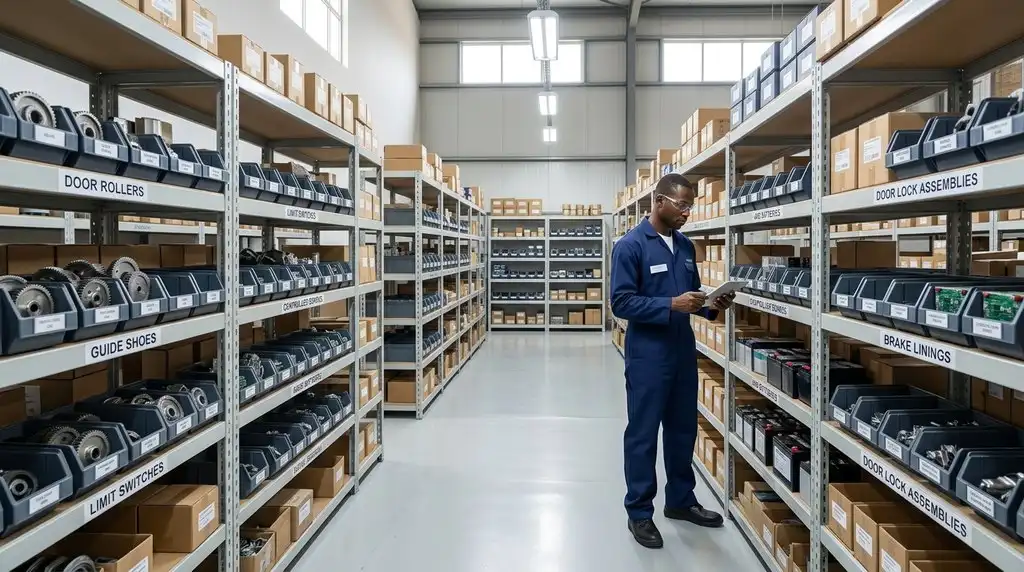
An elevator does not fail because of a major mechanical catastrophe. It fails because a door roller wore out, a limit switch stuck, or a controller board lost a capacitor. The lift itself is fine. One small part is not.
In that moment, the entire value of your building's vertical transportation depends on one question: is that part available in Nigeria today?
If yes, the lift is back in service in hours. If no, the lift is out of service for weeks while a shipment clears customs. We have seen buildings lose a month of lift service over a component that costs less than a bag of cement.
This guide explains the spare parts reality in Nigeria, which components matter most, and how to structure your parts strategy so a single failure does not become a building crisis.
Hard fact: The most common elevator failure in Nigeria is not a motor or controller fault — it is door system wear. Door rollers, door locks, and door operators account for the majority of breakdown call‑outs in buildings we service.
Why Local Parts Availability Is the Real Differentiator
Every elevator supplier promises quality equipment. Very few promise local parts stock. That difference only becomes visible when something breaks.
The overseas parts cycle looks like this:
- Technician diagnoses the fault.
- Faulty component identified, part number confirmed.
- Order placed with manufacturer or distributor overseas.
- Part manufactured or picked from overseas stock.
- International shipping — typically 2 to 6 weeks.
- Customs clearance — typically 1 to 3 weeks, sometimes longer if documentation is incomplete.
- Local delivery to site.
- Installation and testing.
Total realistic wait: four to ten weeks. During that entire period the lift is out of service.
The local stock cycle looks like this:
- Technician diagnoses the fault.
- Part collected from Lagos warehouse.
- Installation and testing.
Total: hours to a few days.
Hard fact: A lift out of service for six weeks in a commercial building represents six weeks of tenant complaints, potential rent abatement claims, and — for a hospital — six weeks of compromised patient transport. The part costs a fraction of that loss.
This is why we maintain an inventory of critical elevator components in Lagos. Not as a marketing line — as an operational necessity in a market where import lead times are measured in months.
Bridge: Knowing local stock matters is one thing. Knowing which parts to prioritise is another.
The Parts That Actually Fail — And Should Be Stocked
Not every component fails at the same rate. A sensible spares strategy focuses on the parts that break most often and are hardest to source quickly.
Door system components. This is the highest‑failure category by a wide margin. Door rollers, door hangers, door locks and interlocks, door operator belts, and door closing springs. A building with eight lifts and no door rollers in stock is a building waiting for a shutdown.
Limit switches and safety switches. These small electromechanical components fail with dust ingress and vibration — both abundant in Nigerian installations. They are inexpensive and should always be held locally.
Guide shoes and rollers. Wear items that affect ride quality and noise. Replacement is routine and predictable.
Brake components. Brake linings and brake coils. Brake issues are safety‑critical and cannot be deferred.
Controller and drive components. Controller boards, VVVF drive modules, contactors, and relays. These are expensive to stock in depth, but a supplier who holds common boards locally transforms recovery time.
ARD batteries. The automatic rescue device battery degrades with heat and time. In Nigerian conditions, replacement is a scheduled event, not a surprise — but only if the battery is available when due.
Travelling cables and wiring components. Less frequent, but a travelling cable failure stops the lift completely.
Hydraulic components. For hydraulic lifts: seals, valves, and pump components. Seal failure is common in older units.
Hard fact: Door rollers, guide shoes, and limit switches together account for the majority of routine elevator repairs. These are low‑cost parts, and their local availability determines whether most breakdowns are resolved in a day or a month.
Bridge: Buying the right parts is only half the problem. Where they are stored matters just as much.
Consignment Stock — The Strategy Large Buildings Use
For buildings with multiple lifts, or single lifts that absolutely cannot afford downtime, there is a better arrangement than relying on the supplier's warehouse.
Consignment stock means a reserve of critical spare parts is stored on your premises, owned by the supplier until used. You pay only when a part is consumed.
Why this works:
- Zero diagnostic delay. The technician arrives with the fault already identified conceptually and the part already in the building.
- No transport time. No waiting for a part to be dispatched from a warehouse across Lagos traffic.
- Immediate restoration. Most routine repairs are completed in a single visit.
- No capital tied up. You do not pay for the stock until it is used. The supplier carries the inventory risk.
What a typical consignment kit contains: door rollers, guide shoes, limit switches, fuses, door lock components, and an ARD battery for the specific lift model.
Hard fact: For hospitals and high‑traffic commercial buildings, a consignment stock arrangement reduces average repair time from days to hours. The parts sit idle most of the time — which is exactly the point.
We offer consignment arrangements for buildings with multiple lifts or critical single‑lift installations. For hospital applications specifically, our guide on hospital elevator maintenance schedules explains how consignment fits into the wider maintenance programme.
Bridge: For buildings without a consignment arrangement, the next best protection is knowing which brand to buy in the first place.
Why Brand Choice Determines Your Parts Future
This is the decision that is hardest to reverse. Before you buy an elevator, you are also choosing a parts supply chain.
Brands with local support infrastructure. Some manufacturers maintain authorised distributors in Nigeria with genuine parts stock, trained technicians, and documented component catalogues. These lifts are straightforward to maintain and repair.
Brands without local support. A lift imported directly from an overseas manufacturer with no Nigerian presence can be excellent equipment. But when it fails, every part is an international order. Documentation may be incomplete, component numbers may be unclear, and compatible substitutes may not exist.
The compatible parts question. For common components — door rollers, guide shoes, limit switches — compatible alternatives often exist and work well. For proprietary components — controllers, drives, and machine parts — compatibility is limited or non‑existent.
Hard fact: A lift whose controller or drive is proprietary and unsupported locally becomes a full modernization candidate the moment that component fails, regardless of the condition of the rest of the lift.
This is one of the reasons we recommend buyers ask a specific question before purchase: what is the local stock position for the components most likely to fail on this model? If the answer is vague, the parts problem is being deferred to you.
Bridge: Once you know what to stock and why brand matters, here is how to build a practical parts plan.
Building a Practical Spares Plan for Your Building
A spares plan does not need to be elaborate. It needs to cover the failures that actually happen.
For a single home lift:
- Door rollers and guide shoes for your model
- Limit switches
- ARD battery (replaced on schedule, not on failure)
- Fuses and basic electrical spares
These are inexpensive and cover the majority of residential breakdowns.
For a commercial building with one or two lifts:
- The home lift list above
- Door lock and interlock components
- Brake lining set
- A controller board if the model is common and the board is locally available
For a multi‑lift commercial building or hospital:
- Consignment stock arrangement with the maintenance provider
- Full door system spares for each lift model
- ARD batteries for all units
- Controller and drive spares for at least one unit's worth of redundancy
- Hydraulic seals if applicable
For a mixed portfolio across multiple buildings:
- Central stock at a facilities management level, with a defined minimum holding
- Standardised lift models where possible, so one parts pool serves multiple buildings
Hard fact: Standardising on a small number of lift models across a property portfolio dramatically reduces spares complexity. One parts pool can serve every building, and technicians become expert on a smaller set of systems.
Bridge: There is one more category of parts problem worth understanding — the counterfeit and incompatible parts market.
Counterfeit and Incompatible Parts — A Real Risk in Nigeria
The Nigerian market has a well‑documented problem with counterfeit and substandard components across many industries. Elevator parts are not immune.
Why it matters: A counterfeit brake lining may fail under load. A substandard limit switch may not stop the car at the correct position. A copied controller board may fail within weeks and damage the drive when it does. These are not cosmetic risks — they are safety risks.
How to reduce exposure:
- Source parts through the original supplier or an authorised distributor where possible.
- For compatible alternatives, verify the specification — not just the fit.
- Be cautious of parts priced far below the normal market rate. There is usually a reason.
- Keep records of every part installed, including source and specification. This matters for SON inspection and for diagnosing repeat failures.
Hard fact: Safety‑critical components — brakes, overspeed governors, door interlocks, and buffers — should never be substituted with unverified compatible parts. The cost saving is trivial compared to the liability exposure.
Bridge: These are the questions building owners ask us most often about spare parts.
Frequently Asked Questions
Which spare parts should every building with a lift keep on site?
At minimum: door rollers, guide shoes, limit switches, and fuses for your specific model. For buildings with a maintenance contract, the provider should hold these locally. For critical buildings, a consignment stock arrangement is better than relying on the supplier's warehouse.
How long does it take to get an elevator part in Nigeria if it is not locally stocked?
Realistically four to ten weeks, depending on the part, the manufacturer's stock position, and customs clearance. This is why local availability is the single most important factor in recovery time.
Can compatible parts be used instead of original manufacturer parts?
For common mechanical components, often yes — provided the specification is verified, not just the physical fit. For safety‑critical components and proprietary electronics, compatible substitution is risky and generally not advisable.
Do all elevator suppliers in Nigeria keep spare parts locally?
No. Many sell equipment and order parts on demand. Before purchasing, ask specifically what parts are held locally, where they are stored, and what the lead time is for a door roller or a controller board.
How often should an ARD battery be replaced?
Performance‑based rather than calendar‑based. In Nigerian heat, sealed lead acid batteries commonly need replacement in the two to four year range. Battery capacity should be tested at every service, and replacement planned before it fails.
Is it worth keeping a controller board in stock?
For a building with multiple lifts of a common model, yes. For a single lift with a proprietary controller, the cost may be hard to justify — in which case knowing the lead time becomes the critical planning input.
What records should we keep for spare parts?
Record every part installed, the date, the source, and the specification. This supports SON inspection, helps identify recurring failure patterns, and prevents the same faulty part being replaced repeatedly with the same substandard alternative.
Hard fact: Spare parts records are part of the maintenance evidence reviewed during SON inspection. A building that cannot document its parts history is treated as having an unverified maintenance record.
Want to Know What Parts Your Building Should Hold?
Most buildings discover their parts gap at the worst possible moment — when something has already failed.
We can tell you in advance. We will assess your lift models, identify the components most likely to fail, confirm what is available from our Lagos stock, and recommend a parts plan appropriate to your building type. For multi‑lift and hospital installations, we can structure a consignment arrangement so the right parts are already in the building.
We do not publish fixed prices for parts, because availability and specification vary by model. What we can do is give you a written parts plan with a clear list of what to hold, what to source on demand, and what lead times to expect.
Send us your lift details — brand, model if known, number of stops, and number of units. We will tell you what your parts position actually looks like.
👉 Speak to Dove Lifts about elevator spare parts
Dove Lifts — Traction, MRL, hydraulic, and freight elevators installed and maintained across Nigeria and West Africa. Local spare parts stock in Lagos, consignment arrangements for critical buildings, and technicians who arrive with the part already on the van.