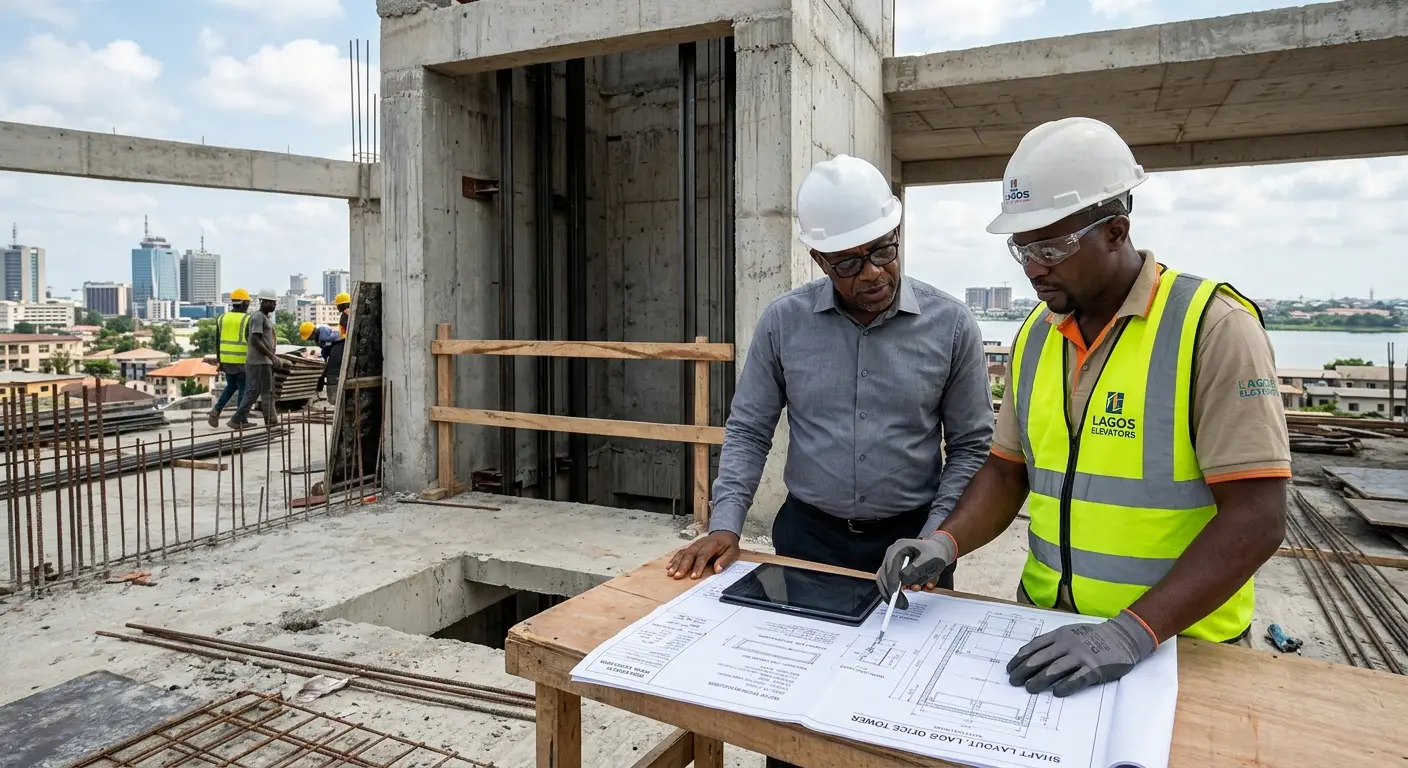
How to Choose an Elevator Company in Nigeria: 10 Questions to Ask Before You Sign
Introduction
An elevator is a twenty‑year decision. The company you choose to supply and install it will determine whether those twenty years are quiet and reliable, or punctuated by breakdowns, unanswered calls, and parts that never arrive.
In Nigeria, the elevator market includes genuine engineering firms, competent local distributors, and a long tail of traders who import equipment, install it with subcontractors, and disappear when something fails. From the outside, their quotations look similar. The difference only becomes visible after the lift is running.
This guide gives you ten questions to ask before signing. None of them require technical knowledge. All of them expose the difference between a company that will support you and one that will not.
Hard fact: SON requires elevator installations to be certified before operation. A company that cannot explain the SON certification process clearly — or that suggests it can be skipped — is not a company to sign with.
Why the Wrong Company Costs More Than the Equipment
The cheapest quotation is rarely the cheapest outcome. Here is what goes wrong when the wrong company installs your lift.
The installation is subcontracted. The company you signed with does not employ the technicians who install the lift. They hire a crew for the job. When something goes wrong, neither party accepts responsibility.
The parts channel does not exist. The lift is an obscure import. When a door roller fails, there is no local stock and no compatible substitute. The lift waits weeks for a part that costs almost nothing.
The maintenance contract is a phone number. No scheduled visits, no response time commitment, no documentation. You call, they answer sometimes, and each repair is charged separately.
The warranty excludes everything that fails. Read carefully, and the warranty covers manufacturing defects in components that almost never fail, while excluding the door system and controller — the parts that actually break.
The certification is missing. The lift operates without a SON Certificate of Conformity. When an incident occurs, the building owner carries the liability.
Hard fact: Liability for an elevator incident in Nigeria falls on the building owner, not the supplier, when the installation is non‑compliant. A cheap installation with missing certification transfers the risk to you.
Bridge: These are the questions that separate the reliable companies from the rest.
Question 1: Are They SON Certified, and Can They Prove It?
This is the first question and the most important. Do not accept a verbal assurance.
What to ask: "Show me your SON certification for a similar installation, and explain the full certification process from CAP to final Certificate of Conformity."
What a good answer looks like: They explain the SON CAP pre‑import certificate, the installation process, the final inspection, and where the Certificate of Conformity is displayed. They can show you a recent certificate from a completed project. They handle the process for you.
What a bad answer looks like: Vague references to "standards", claims that certification is "not required for smaller lifts", or an offer to "sort it out later". Any of these means the company does not routinely certify its installations.
Hard fact: A valid SON Certificate of Conformity must be displayed inside the elevator car. If you visit a building with their lift installed and there is no certificate, that is your answer.
Question 2: Do They Hold Local Spare Parts Stock?
This determines how long your lift stays out of service when something fails.
What to ask: "What spare parts do you hold in stock in Nigeria for this lift model, and what is the lead time for a door roller and a controller board?"
What a good answer looks like: They name specific parts held locally — door rollers, guide shoes, limit switches, controller boards for common models. They give realistic lead times: days for stock items, weeks for non‑stock items. They can explain their warehouse arrangement.
What a bad answer looks like: "We order as needed" or "the manufacturer ships quickly". This means every failure is an international order with customs clearance attached. Expect four to ten weeks of downtime.
Hard fact: Door system components account for the majority of elevator breakdowns in Nigeria. A company that does not hold door rollers locally will leave your lift out of service for weeks over a part that costs very little.
For a full breakdown of which parts matter, see our guide on elevator spare parts in Nigeria.
Question 3: Who Actually Installs the Lift?
The installation quality determines the next twenty years of reliability.
What to ask: "Are the technicians who will install this lift your direct employees, and can I meet the installation supervisor before signing?"
What a good answer looks like: They employ their own installation team, the supervisor is named, and you can meet them. They can describe how they train and certify technicians.
What a bad answer looks like: "We have a team we work with" or "installation is handled by our partner". This is subcontracting. When something goes wrong, responsibility becomes unclear.
Hard fact: Rail alignment, door installation, and controller commissioning determine ride quality and safety device function. Poor installation causes problems that no maintenance contract can fully correct.
Question 4: What Does the Maintenance Contract Actually Cover?
The maintenance contract is where most building owners discover the gap between what they thought they bought and what they actually have.
What to ask: "Show me a sample maintenance contract. What is included, what is excluded, and what is the guaranteed response time?"
What a good answer looks like: A written contract with a defined number of scheduled visits, a list of included services, a response time commitment, and clear exclusions. They explain what counts as consumable and what is charged separately.
What a bad answer looks like: A verbal promise of "we will look after you" or a contract that excludes parts entirely with no cap. This is a breakdown‑only arrangement dressed up as maintenance.
Hard fact: A preventive maintenance contract with scheduled visits and documented reporting is significantly cheaper over the lift's life than breakdown‑only servicing — and it is required for SON compliance documentation.
For what a contract should include, see our guide on elevator maintenance contract costs in Nigeria.
Question 5: Can You Visit a Completed Project?
References on a website are marketing. A working lift you can inspect is evidence.
What to ask: "Can I visit a building where you installed a similar lift at least two years ago, and speak to the facility manager?"
What a good answer looks like: They arrange a visit to a real installation, ideally one that has been running for several years. The facility manager is available to speak. You can inspect the lift, the certificate in the cab, and the maintenance log.
What a bad answer looks like: "Our projects are confidential" or a reference that turns out to be a lift installed three months ago. Recent installations have not been tested by time.
Hard fact: A lift installed two or three years ago reveals everything — ride quality, door performance, noise, and whether the maintenance log has been kept up. Ask to see the log book.
Question 6: What Is Their Response Time Guarantee — In Writing?
Every company claims to respond quickly. The contract is where that claim becomes enforceable.
What to ask: "What is your guaranteed response time for a breakdown in my area, and what happens if you miss it?"
What a good answer looks like: A specific response time written into the contract — for example, a defined number of hours for Lagos Island versus Lagos Mainland versus other states. A penalty clause or service credit if the response time is missed.
What a bad answer looks like: "As soon as possible" or "we are always available". Without a written commitment and a consequence for missing it, the response time is aspirational.
Hard fact: A lift out of service for a full working day in a commercial building affects every tenant and every visitor. Response time is not a detail — it is the core of what a maintenance contract delivers.
Question 7: Do They Handle Permits and SON Certification?
The regulatory process is not optional, and a company that does not routinely handle it will leave it to you.
What to ask: "Which permits will you handle on my behalf, which will I need to obtain, and what is the expected timeline?"
What a good answer looks like: A clear list of what they handle — SON CAP before import, LASG Building Control approval for the shaft, fire service approval where relevant, and final SON inspection. They explain the timeline and what they need from you.
What a bad answer looks like: "You will need to sort out permits" for the majority of the process, or claims that permits are not needed for certain building types.
Hard fact: Operating a lift without SON certification exposes the building owner to fines and, in the event of an incident, to direct liability. The permitting process is part of the installation, not a separate errand.
For the full permit sequence, see our guide on SON and LASG elevator compliance.
Question 8: What Warranty Do They Offer, and What Voids It?
Warranty terms are frequently misunderstood, because the exclusions matter more than the headline period.
What to ask: "What exactly does the warranty cover, what voids it, and what is the claims process if something fails in the first year?"
What a good answer looks like: A written warranty covering parts and labour for a defined period, with exclusions clearly stated — typically power surges, vandalism, and damage from water ingress. The claims process is described. They explain what you must do to keep the warranty valid, usually including scheduled maintenance.
What a bad answer looks like: "Two years warranty" with no written terms, or terms that exclude the door system and controller. Also common: a warranty that is void if maintenance is done by anyone else, without that being made clear upfront.
Hard fact: Almost every manufacturer warranty is void if the lift is not maintained to schedule by an approved provider. If you plan to use a different maintenance company, confirm this before signing.
Question 9: How Do They Handle Power‑Related Failures?
In Nigeria, this question separates companies who understand the market from those who do not.
What to ask: "Does this lift include an Automatic Rescue Device as standard, and how is it tested and maintained?"
What a good answer looks like: Yes, ARD is standard, not an optional extra. They explain how it works, how often it is tested, and what happens to the battery over time. They can explain the difference between ARD and generator backup.
What a bad answer looks like: ARD is offered as an optional add‑on, or the company cannot clearly explain how it works. Any suggestion that a generator alone is sufficient protection indicates a company that has not thought about Nigerian conditions.
Hard fact: SON requires an ARD on new passenger elevator installations in Nigeria. A lift without one is non‑compliant, and the building owner carries the liability if a passenger is injured during an entrapment.
For the full picture on power protection, see our guide on NEPA‑proof elevators.
Question 10: What Happens When the Lift Breaks Down at 2am?
This is the question that exposes whether the maintenance contract is real.
What to ask: "If the lift traps a passenger at 2am on a Saturday, who do I call, what happens, and how quickly will someone arrive?"
What a good answer looks like: A named 24/7 number, a described escalation process, and a realistic response time. They can explain who is on call and what the technician can do remotely versus on site.
What a bad answer looks like: An office number, a promise to "call the engineer in the morning", or surprise that the question was asked. This is a company with a daytime operation and no emergency capability.
Hard fact: An entrapped passenger at night is a safety incident, not an inconvenience. A company without a genuine 24/7 response capability is not providing the service a lift requires.
Red Flags to Walk Away From
Beyond the ten questions, these are the warning signs we hear about from building owners who chose badly.
Pressure to sign quickly. A genuine company will give you time to compare. Urgency is a sales tactic.
No physical address you can visit. A company operating from a phone number and a website has no warehouse, no stock, and no service infrastructure.
Quotation that does not separate equipment, installation, and civil works. If the quote is a single figure, you cannot tell what you are paying for — or what is missing.
Refusal to provide a written maintenance contract before installation. Maintenance is where the real cost sits. A company that will not commit in writing before the sale will not commit after it.
No certification evidence from previous projects. Ask to see a Certificate of Conformity from a recent installation. If they cannot produce one, they do not routinely certify.
Hard fact: The most common complaint we hear from building owners who chose a cheaper supplier is not about the equipment. It is about the absence of local spare parts and the failure to respond when the lift breaks down.
How to Compare Quotations Fairly
Three quotations that look different are hard to compare. Make them comparable.
Ask for the same scope in the same format. Equipment, installation, civil works, electrical works, permits, training, and first‑year maintenance should be separate line items in every quote.
Compare what is included, not just the total. A lower total with civil works excluded is not lower. It is incomplete.
Ask each company to state the response time and spare parts position in writing. These are the two factors that determine long‑term cost, and they are invisible in a quotation total.
Ask each company for one reference you can visit. Then visit it.
Compare the maintenance contract terms side by side. Number of visits, included parts, response time, and exclusions.
Hard fact: A quotation that does not separate civil works from equipment cannot be compared with one that does. Before comparing totals, confirm that every quote covers the same scope.
Frequently Asked Questions
How do I verify a company's SON certification is genuine?
Ask for the Certificate of Conformity from a recent installation and check the certificate number with SON. Visit a completed building and look for the certificate displayed inside the lift car.
Is the cheapest quotation always the worst option?
Not automatically, but the cheapest quote usually excludes something — civil works, permits, first‑year maintenance, or genuine local parts stock. Compare scope, not just totals.
Should I use the same company for installation and maintenance?
Generally yes. A single company carries clear responsibility for performance, the warranty remains valid, and there is no dispute between installer and maintainer when something fails.
How long should the warranty be?
Twelve to twenty‑four months on parts and labour is typical. What matters more than the length is what is covered and what voids it. Read the exclusions carefully.
Can I buy the elevator from one company and have another install it?
Possible but not advisable. Responsibility for performance becomes unclear, and most warranties are void if installation is not done by the supplier or an approved partner.
What should I do if a company cannot provide a reference I can visit?
Treat it as a serious warning sign. Any company with genuine installations can arrange a visit. Refusal usually means there is nothing worth seeing.
How do I compare maintenance contracts?
Line up the number of scheduled visits, the included parts, the guaranteed response time, the exclusions, and the annual cost. The contract with the most visits and the clearest response time is usually the best value, even if it is not the cheapest.
Hard fact: A maintenance contract with a written response time and a penalty clause is fundamentally different from one without. Ask for both before signing.
Choosing an Elevator Company in Nigeria?
You now have ten questions that separate a company that will support you for twenty years from one that will disappear after handover. Use them on every quotation you receive — including ours.
We are happy to answer all ten, provide references you can visit, show you our local spare parts stock, and put our response times and warranty terms in writing before you commit to anything.
We do not publish fixed prices, because every installation is engineered around a specific building. What we can do is survey your site, give you a written quotation with all cost categories separated, and answer every question on this list without hesitation.
Send us your building details and intended lift specification. We will give you the answers in writing.
👉 Speak to Dove Lifts about your elevator project
Dove Lifts — Traction, MRL, hydraulic, and freight elevators installed and maintained across Nigeria and West Africa. Local spare parts stock in Lagos, SON‑certified installations, and maintenance contracts with response times in writing.