Introduction
There is a moment in every old building's life when the elevator stops being an asset and becomes a liability. It stops between floors. The doors open too slowly. The controller throws faults nobody can diagnose. Tenants start complaining, and the maintenance technician is on site every week.
At that point, most building owners assume the only option is a full replacement. That assumption is often expensive and unnecessary.
Modernization keeps the existing shaft, guide rails, and often the machine itself, and replaces the components that have reached end of life — controller, drive, doors, fixtures, and safety devices. The result is a lift that behaves like a new one, at a fraction of replacement cost, with far less disruption to the building.
This guide explains when modernization is the right call in Lagos, what it actually involves, and how to plan the project around a live building.
Hard fact: An elevator modernized with a new microprocessor controller, VVVF drive, and compliant safety devices can meet current SON requirements without changing the shaft, machine room, or structural elements of the building.
Signs Your Elevator Needs Modernization, Not Just Repair
The distinction matters, because repair spending on a lift that should be modernized is money that never returns.
Sign 1: Repeated faults with no clear cause. Old relay logic and early microprocessor controllers throw intermittent faults that depend on temperature, humidity, and voltage. A technician resets the lift, it runs for two weeks, then faults again. This pattern is characteristic of a controller at end of life.
Sign 2: Parts that take weeks to source. If every repair involves waiting for an obsolete component from overseas, you are paying a downtime cost far larger than the part. This is common with lifts installed in the 1990s and 2000s whose manufacturers no longer supply spares.
Sign 3: Energy bills that stand out. Old geared traction machines and non‑VVVF drives consume substantially more power than modern equivalents. On a Lagos Band A tariff, an inefficient lift running heavy traffic is a visible line in the building's electricity account.
Sign 4: Safety devices that do not meet current standards. No ARD. No fire recall. Door interlocks that pass mechanically but would not survive a SON inspection. This is a compliance problem, not just a reliability problem.
Sign 5: Passenger complaints that keep coming. Jerky stops, poor levelling, slow doors, and noise. Each is individually fixable. Together they indicate a system that has fallen behind modern expectations.
Sign 6: Rising maintenance spend with no improvement in reliability. If your annual maintenance cost is climbing while uptime is falling, the lift has passed the point where repair is economical.
Hard fact: SON requires an Automatic Rescue Device on new passenger elevator installations in Nigeria. Older lifts without one are effectively non‑compliant, and modernization is the practical route to bringing them into compliance without replacing the shaft.
Bridge: Once you accept that modernization is the answer, the next question is what actually gets replaced.
What Modernization Actually Replaces
A full modernization is not a cosmetic refurbishment. It replaces the systems that control, drive, and protect the lift.
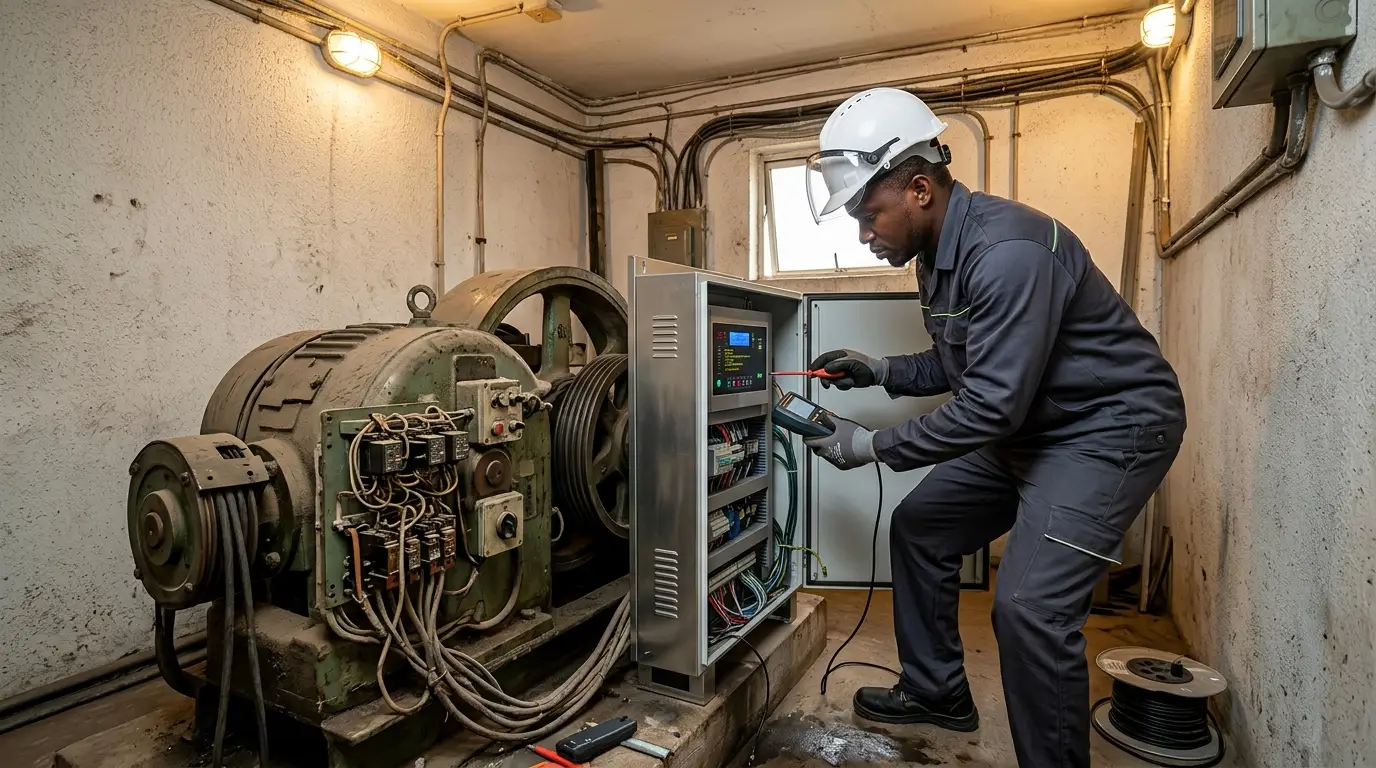
The controller. The brain of the elevator. Modern units are microprocessor‑based, self‑diagnosing, and support remote monitoring. They also enable destination dispatch if the building needs it. This is the single most impactful upgrade for reliability.
The drive. The VVVF (variable voltage variable frequency) drive controls motor speed and acceleration. It is responsible for smooth ride quality and a large share of the energy saving. Old resistance‑based starting systems waste power as heat; VVVF drives do not.
The door operator and doors. Most lift complaints are door complaints. A modern door operator with adjustable speed, reliable reopening sensors, and VVVF control transforms the passenger experience. Where door panels and tracks are worn, they are replaced too.
The car fixtures and landing fixtures. Buttons, indicators, position displays, emergency intercom, and lighting. Modern fixtures improve reliability and address accessibility requirements including braille and voice announcement.
Safety devices. Overspeed governor verification, brake refurbishment or replacement, buffers, and critically, an Automatic Rescue Device. This is where modernization delivers the most direct compliance value.
What is usually retained: the guide rails, the shaft structure, the machine room (if present), the counterweight, and frequently the traction machine or hydraulic cylinder if they are in good condition.
Hard fact: Retaining the guide rails and machine is what makes modernization cost‑effective. Those elements represent a significant share of the original installation value and typically have a service life far longer than the control and drive components.
Bridge: That said, modernization is not always the right answer, and it is worth being direct about when replacement wins.
Modernization vs Full Replacement — An Honest Comparison
Modernization is usually cheaper and faster. Replacement is sometimes unavoidable. Here is how to tell which applies.
Modernization is the right choice when:
- The shaft dimensions meet current standards for cab size and clearances
- The guide rails and structure are sound and within plumb tolerance
- The machine (traction or hydraulic) is mechanically healthy
- The building will not be significantly modified in the next decade
- Disruption to occupants must be minimised
- The lift is between roughly fifteen and thirty years old
Replacement is usually necessary when:
- The shaft is too small to meet current standards for stretcher access or accessibility
- The guide rails are out of tolerance and cannot be corrected economically
- The hydraulic cylinder has failed or the jack is corroded beyond repair
- The building is being converted to a different use requiring different capacity or speed
- Structural work is needed that makes replacement more sensible than modernization
Hard fact: If the existing shaft dimensions cannot accommodate a compliant cab, modernization cannot solve the problem. Cab size is fixed by shaft geometry, and no controller upgrade changes that.
For buildings where the shaft itself is the limitation, our guide on elevator retrofit in Lagos covers the structural options including external shafts.
Bridge: With the choice clear, the practical question is what drives the modernization budget.
What Drives the Modernization Budget in Lagos
We do not publish fixed modernization figures, because the scope varies enormously from project to project. What we can do is explain the variables.
Scope of replacement. A controller‑only modernization is a different project from a full modernization covering controller, drive, doors, fixtures, and safety devices. Controller‑only addresses reliability; full modernization addresses reliability, energy, compliance, and passenger experience together.
Lift type. Traction, MRL, and hydraulic lifts require different components. Hydraulic modernizations often include pump unit and valve replacement. Traction modernizations may include machine refurbishment.
Number of stops. Each landing has fixtures, doors, and wiring that may need replacement. More stops means more of everything.
Building condition. Working in an occupied Lagos building, with restricted hours and limited access to the shaft, costs more than working in an empty one.
Compliance requirements. Adding an ARD, fire recall, and accessibility features adds cost — but these are requirements, not optional extras.
Brand and parts availability. A lift from a manufacturer with local support is easier to modernize than an obscure import with no documentation and no spares channel.
Energy performance. A modern VVVF drive delivers a substantial reduction in energy consumption. On buildings with high lift usage and Band A electricity, this saving contributes meaningfully to the payback calculation.
Hard fact: Modernization cost is typically a fraction of full replacement cost for the same lift, because the shaft, rails, machine, and structural works are retained. The exact fraction depends on how much of the original installation can be reused.
Bridge: Cost is one concern. Downtime is usually the bigger worry for a live building.
The Downtime Question — Modernizing a Live Building
This is the practical objection every building owner raises, and it is a fair one.
Option 1: Single lift building. If the building has one elevator and no alternative circulation, modernization means the lift is out of service for the duration. The realistic approach is to complete the work as a concentrated programme over a defined number of weeks, notify occupants well in advance, and stage deliveries and heavy movement around it.
Option 2: Multiple lifts in a bank. Modernize one lift at a time while the remaining units carry the building's traffic. This is the standard approach in Lagos office towers. Total project duration is longer because the units are done sequentially, but the building never loses vertical transportation entirely.
Option 3: Staged work with night and weekend shifts. For buildings where even partial daytime loss is unacceptable, work can be concentrated outside business hours. This extends the programme and increases labour cost, but keeps the lift available during working hours.
What determines the duration: the scope. Controller and drive replacement is a shorter programme than a full modernization involving doors, fixtures, and safety devices.
Hard fact: During modernization, the lift must be isolated and locked out with the pit, car top, and machine room secured. Occupant safety during the works depends on correct isolation — this is a non‑negotiable part of the programme.
For multi‑tenant buildings, we recommend agreeing a communication plan with building management before work starts, including notice periods and expected daily availability.
Bridge: One more factor makes modernization urgent rather than optional for many Lagos buildings.
Compliance: Why Old Lifts Fail SON Today
Many lifts installed in Lagos in the 1990s and 2000s met the standards of their time. They do not meet current expectations, and some will not pass inspection.
What SON inspectors check that old lifts frequently fail:
- Automatic Rescue Device. Required on new installations. Absent on most older lifts.
- Door interlock integrity. Mechanical wear can allow doors to be opened when the car is not present — a serious safety failure.
- Overspeed governor function. Must trip at the correct speed. Seldom tested on older lifts until failure.
- Emergency communication. An intercom or phone that reaches an attended point, with battery backup.
- Fire recall operation. Phase 1 and Phase 2 fireman's operation, verified functional.
- Load test and brake holding. Documented 125% load test with no drift.
Hard fact: You cannot legally operate a passenger elevator in Nigeria without a valid SON Certificate of Conformity displayed in the cab. Operating without one exposes the building owner to fines and, in the event of an incident, to liability.
Modernization is usually the cheapest compliant path. It brings the existing installation up to current safety standards without the cost and disruption of replacement. Our guide on SON and LASG elevator compliance sets out the full requirement.
Bridge: With all of that understood, here is how to structure the project.
How to Plan a Modernization Project
A modernization that runs well is one that was assessed properly before any equipment was ordered.
Step 1: Condition assessment. A full survey of the existing lift — controller type, drive type, machine condition, rail plumb, door condition, safety devices, and wiring. This determines what can be retained and what must be replaced.
Step 2: Compliance gap analysis. Compare the installation against current SON requirements. This produces the mandatory scope — what must be done regardless of budget.
Step 3: Define the scope. Mandatory works, plus optionally: energy upgrade, ride quality upgrade, and fixture aesthetics.
Step 4: Parts availability check. Confirm which components are available locally and which must be imported, and what that means for the programme.
Step 5: Agree the downtime plan. Single lift, sequential across a bank, or out‑of‑hours working.
Step 6: Execute with documentation. Every replacement documented, every safety device tested, and a full commissioning record prepared for SON inspection.
Hard fact: Modernization records — controller documentation, load test results, safety device verification, and wiring diagrams — form the evidence base for the SON Certificate of Conformity. Undocumented work is treated as no work.
Bridge: These are the questions building owners ask us most often about modernization.
Frequently Asked Questions
How do I know if my elevator needs modernization or replacement?
If the shaft dimensions and structure are sound, the guide rails are within tolerance, and the machine is healthy, modernization is usually the better value. If the shaft is undersized for current standards or the machine and rails are worn out, replacement is more sensible. This requires a site assessment to answer properly.
How long does elevator modernization take in Lagos?
It depends on scope and whether the building has other lifts. Controller‑only work is a shorter programme than a full modernization including doors, fixtures, and safety devices. For a bank of lifts, modernization is typically done one unit at a time.
Can we modernize a lift while the building is occupied?
Yes. In buildings with multiple lifts, work is done sequentially so circulation continues. In single‑lift buildings, the work is concentrated into a defined outage period with advance notice to occupants, or scheduled outside business hours.
Will modernization reduce our energy costs?
Usually significantly. Replacing an old resistance‑based starting system with a VVVF drive reduces energy consumption substantially. Adding LED car lighting and standby mode reduces it further. We can quantify the expected saving as part of the proposal.
Does modernization bring the lift into SON compliance?
Yes, when the mandatory safety scope is included — ARD, verified door interlocks, overspeed governor testing, emergency communication, and fire recall. This is normally the main driver for modernizing rather than continuing to repair.
Can we modernize a lift from a brand the manufacturer no longer supports?
Often yes. Independent modernization uses current‑generation controllers and drives that are not tied to the original manufacturer. This is one of the main advantages — it removes dependence on an obsolete parts channel.
What happens to the old machine during modernization?
If the traction machine or hydraulic pump unit is in good condition, it is retained. If worn, it is refurbished or replaced as part of the scope. This is decided during the condition assessment.
Do we need to vacate the building during modernization?
No, except where a single lift serves the whole building and no alternative circulation exists. Even then, the outage is limited to the working period rather than the full project duration.
Hard fact: An overspeed governor that has never been tested may not trip at the correct speed. This is one of the most common findings during modernization surveys and a direct safety risk on older Nigerian lifts.
Thinking About Modernizing Your Lagos Elevator?
Modernization is usually cheaper than replacement, faster, and far less disruptive. But it only works when the existing shaft, rails, and machine justify retention — and that requires an assessment, not an assumption.
We will survey your lift, identify what can be retained, produce a compliance gap analysis against current SON requirements, and give you a written proposal with the scope clearly separated into mandatory works and optional upgrades. No obligation, and no figures invented to win the job.
Send us your lift details — age, brand if known, number of stops, and current issues. We will tell you whether modernization is the right path and what it involves.