Introduction
Every Nigerian building owner has had the thought. A passenger is inside the lift. NEPA takes light. What happens next?
For buildings with older installations or cheap imported units, the honest answer is: the passenger waits. Sometimes for twenty minutes. Sometimes for two hours. In the worst documented cases, longer.
For buildings specified correctly — with an Automatic Rescue Device installed and maintained — the answer is very different. The lift detects the outage, takes control of its own descent, arrives at the nearest floor, and opens the doors. The passenger walks out.
This guide explains how power outage protection actually works on Nigerian elevators, what the different backup options really do, and what to insist on before you buy.
Hard fact: SON requires an Automatic Rescue Device on new passenger elevator installations in Nigeria. A lift without one is not compliant, and an uncompliant lift creates direct liability for the building owner if a passenger is injured during an entrapment.
What Actually Happens When the Power Fails
The behaviour depends entirely on what backup system is installed. There are four common scenarios in Nigerian buildings.
Scenario 1: No backup at all. The drive loses power, the brake engages, and the car stops wherever it is — possibly between floors. Cab lighting may go out unless there is a battery‑backed emergency light. The alarm bell works on its own battery. The passenger waits for a technician or security staff to perform a manual rescue.
Scenario 2: Generator backup only. The building generator starts and the changeover switch transfers. But there is a gap between the outage and the generator taking load — typically five to fifteen seconds, sometimes longer for larger generators. During that gap the elevator has already stopped and faulted. It may require a technician to reset before it will run again, which means the passenger is still trapped.
Scenario 3: Generator plus ARD. The ARD bridges the gap instantly — within about a second of power loss it takes control and begins descending. When the generator takes load, the lift resets and returns to normal service. The passenger is already out. This is the arrangement we recommend for most commercial buildings.
Scenario 4: ARD only, no generator. The lift descends safely to the nearest floor and the passenger exits. The lift then goes into standby. It will not run again until mains power returns. Suitable for smaller buildings where full backup operation is not required.
Hard fact: An ARD is designed for one safe descent, not continuous operation. It is a rescue device, not a power supply. Buildings that need the lift to keep running through an outage require a generator or a dedicated UPS, not an ARD alone.
Bridge: Understanding the difference between these systems is the single most important purchasing decision for a Nigerian building.
How an Automatic Rescue Device (ARD) Works
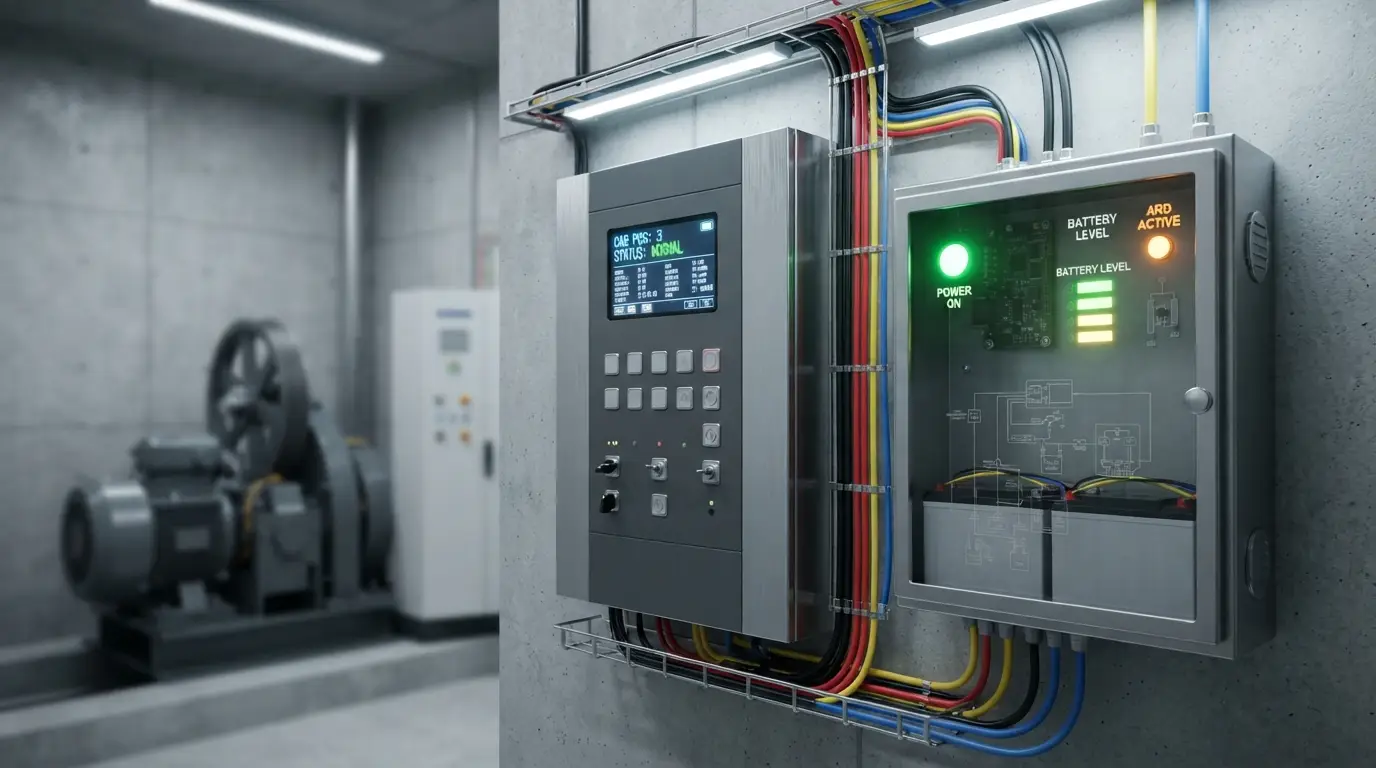
An ARD is a battery‑backed unit that sits between the mains supply and the elevator controller. It monitors incoming power continuously.
What happens in sequence:
- Mains power fails. The ARD detects the loss within a fraction of a second.
- The ARD switches the elevator onto battery supply before the controller faults.
- The controller identifies the car position and direction of the nearest landing.
- The drive releases the brake and moves the car at reduced speed — usually around 0.1 to 0.2 metres per second.
- The car arrives at the nearest floor, levels, and opens the doors.
- The passenger exits. The doors close and the lift goes into standby.
- When mains power returns, the ARD returns the lift to normal operation.
The entire descent sequence typically completes in under a minute, depending on how far the car is from the nearest landing.
Why the nearest floor and not the ground floor: Moving to the nearest landing minimises battery drain and rescue time. Descending all the way to ground floor could take several minutes and would consume far more battery capacity.
Hard fact: The ARD battery must be sized to complete the descent under full load, not just an empty car. A unit sized for an empty car may fail to complete the sequence if the lift is loaded when the outage occurs.
Bridge: Beyond ARD, there are two other protection approaches, and knowing when each applies matters.
Generator Synchronisation and UPS Backup
An ARD gets passengers out. It does not keep the lift in service. Some buildings need more.
Generator synchronisation means the elevator is wired to the building generator through an automatic transfer switch, so that once the generator is running, the lift operates normally. This is standard for hospitals, hotels, and busy commercial buildings where a lift out of service for hours is unacceptable.
The limitation is the changeover gap. Between mains failure and generator load acceptance, the elevator loses power. Without an ARD, the lift faults and stops. With an ARD, the gap is covered — passengers exit safely, and the lift returns to service once the generator is stable.
There is a second consideration. Elevator motors draw a high starting current — significantly higher than their running current. A generator sized only for the building's general load may not have enough capacity to start the elevator motor, particularly hydraulic units. This is a common specification error in Nigerian buildings: the generator is adequate for lighting and air conditioning but trips when the lift attempts to start.
UPS backup is the third approach, used mainly in healthcare. A medical‑grade UPS with zero transfer time keeps the elevator running continuously through the outage and the generator changeover, with no interruption at all. This is significantly more expensive than an ARD and is specified where patient transport cannot pause — operating theatres, ICUs, and critical care routes.
Hard fact: Elevator starting current can be several times the motor's rated running current. Generator sizing for lift operation must account for this, or the generator will trip when the lift starts — a failure mode we see frequently in Nigerian commercial buildings.
For the healthcare application specifically, our guide on hospital elevator requirements in Nigeria explains the medical‑grade backup standard in detail.
Bridge: The systems are only as good as their maintenance, and this is where most Nigerian buildings fail.
Why Maintenance Decides Whether It Works
An ARD that was installed three years ago and never tested is not protection. It is a box on the wall.
What degrades over time:
- Battery capacity. Sealed lead acid batteries lose capacity gradually and typically need replacement every two to four years in Nigerian conditions. Heat accelerates the decline. A battery that held twenty minutes of backup when new may hold two minutes at year four — not enough to complete a descent.
- Charging circuit. If the charger fails silently, the battery sits discharged and the ARD cannot function when needed.
- Controller parameters. Lift controllers are sometimes replaced or reprogrammed during modernisation without the ARD being reconfigured to match.
- Changeover wiring. Generator changeover panels are modified as buildings expand, and the elevator circuit is sometimes altered without the ARD being re‑verified.
What proper maintenance looks like:
- Monthly test: simulate a power failure and confirm the lift completes a full ARD descent.
- Battery voltage and capacity check at every scheduled service.
- Recorded battery replacement interval based on measured performance, not a fixed calendar.
- Verification that the ARD is correctly integrated with the controller after any modernisation work.
Hard fact: An ARD test must be performed under load, not with an empty car. Testing an empty lift confirms the device activates — it does not confirm it can complete the descent with passengers inside.
This is one of the reasons our maintenance contracts include documented ARD testing as a standard line item, not an optional extra. It also sits alongside the wider maintenance requirements we cover in our guide on elevator maintenance contract costs in Nigeria.
Bridge: With the technical picture clear, here is how to specify protection for your building.
How to Specify Power Protection for Your Building
The right specification depends on what the building does and what a lift outage would cost.
Residential duplex or small office. An ARD is the minimum, and usually sufficient. The lift descends safely during an outage and returns to service when power returns. Generator backup is optional — good to have, but not essential if the building has reliable mains supply or an inverter system.
Commercial office building. ARD plus generator synchronisation. Office buildings cannot afford a lift out of service for hours. The ARD protects passengers during the changeover gap; the generator keeps the lift running afterwards.
Hotel. ARD plus generator, with the lift circuit given priority in the changeover sequence. Guest experience suffers badly when lifts stop, and guests on upper floors with luggage are particularly affected.
Hospital or clinic. Medical‑grade UPS with zero transfer time, backed by generator, plus ARD as an additional layer. Patient transport cannot pause. Our hospital elevator compliance guide sets out the full requirement.
Residential tower with many floors. ARD plus generator. With twenty floors and multiple lifts, an outage without backup means large numbers of residents affected simultaneously. Generator backup is effectively mandatory.
Hard fact: Emergency lighting in the elevator car must operate independently of the main supply, with its own battery. A car that descends safely in darkness causes panic — the lighting battery is a separate requirement from the ARD.
Bridge: These are the questions we are asked most often about power outage protection.
Frequently Asked Questions
What happens if the elevator stops during a NEPA outage and there is no ARD?
The car stops wherever it is, possibly between floors. The passenger uses the alarm or emergency phone. A trained technician then performs a manual rescue — using a manual lowering valve on a hydraulic lift or a hand crank on a traction lift. This can take considerable time depending on technician availability. It should never be attempted by untrained building staff.
Can my generator keep the elevator running during an outage?
Only if the generator is correctly sized for the elevator's starting current and the lift is wired through the changeover panel. Many Nigerian buildings have generators that are adequate for general load but trip when the lift attempts to start. This must be verified during installation, not assumed.
How long does an ARD take to get passengers out?
Typically under a minute from the moment of power loss to doors opening. The exact time depends on how far the car is from the nearest landing and the descent speed, which is deliberately slow for safety.
How often should an ARD battery be replaced?
Performance‑based, not calendar‑based. In Nigerian conditions, sealed lead acid batteries commonly need replacement somewhere in the two to four year range. A lithium option lasts considerably longer at higher upfront cost. Battery health should be checked at every service visit.
Does an ARD work on all elevator types?
ARD units are available for traction, MRL, and hydraulic lifts. The specific unit and battery sizing differ by type and load. It is not a universal part.
Is an ARD required by law in Nigeria?
SON requires an Automatic Rescue Device on new passenger elevator installations. It is not optional, and operating a lift without one exposes the building owner to liability.
What is the difference between an ARD and a UPS?
An ARD performs a single safe descent to the nearest landing and then the lift goes into standby. A UPS maintains continuous normal operation for a defined period. An ARD is a rescue device; a UPS is a power supply. They serve different purposes and are specified differently.
Can I retrofit an ARD to an existing elevator?
Yes, in most cases. It requires the controller to be compatible or adaptable, and the battery to be sized to the specific motor and load. We assess this during a site survey.
Hard fact: Manual rescue of a trapped passenger must only be performed by a trained technician. Untrained staff attempting to release a car between floors has resulted in fatalities internationally, including falls down open shafts.
Want to Know If Your Building Is Actually Protected?
Most building owners in Nigeria assume their lift has backup. Many discover during an outage that it does not — or that the battery has been dead for two years.
We can tell you in a single visit. We will test your ARD under load, check your battery condition, verify your generator synchronisation, and confirm your emergency lighting operates independently. You will get a written report showing exactly what works, what does not, and what needs attention.
We do not publish fixed figures for ARD supply or retrofitting, because battery sizing depends on your lift type, load, and travel height. What we can do is assess your installation and give you a written proposal.
Send us your lift specification and building details. We will tell you what protection your elevator needs and what it will cost.
👉 Speak to Dove Lifts about power outage protection
Dove Lifts — Traction, MRL, hydraulic and freight elevators installed and maintained across Nigeria and West Africa. ARD supply, generator integration, and SON‑compliant power protection for every lift we install.