Introduction
Escalators and elevators both move people vertically — but they solve completely different problems. An escalator is a continuous conveyor: it moves a steady stream of people short distances, all day, without waiting. An elevator is a batch system: it carries a group point‑to‑point, waits for the next call, and repeats.
Choosing the wrong system for your building wastes money and frustrates users. We have specified vertical transportation for malls, hotels, airports, and offices across Nigeria and West Africa. This guide shows you how to decide based on traffic pattern, accessibility law, space, and cost.
Hard fact: Escalators in Nigeria must comply with EN 115‑1, while elevators comply with EN 81‑20/50. These are different safety standards. You cannot assume one certification covers the other.
Continuous Flow vs Point‑to‑Point Transport
The first question is not "which is better?" but "how do people move in my building?"
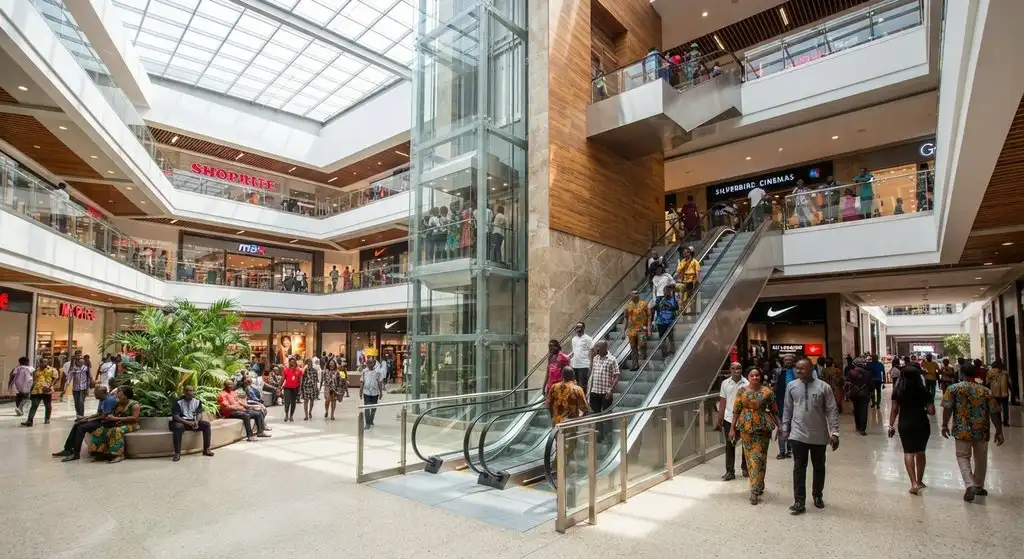
Escalators excel at continuous flow. In a shopping mall, shoppers move between floors repeatedly — browsing, returning, crossing the atrium. An escalator lets them step on without pressing a button and without waiting. There is no queue, no capacity limit per trip, and no door cycle time. This is why retail atriums in Lagos and Abuja almost always use escalators: they keep people moving and keep them shopping.
Elevators excel at point‑to‑point transport. A hotel guest going from the lobby to the 12th floor does not want to ride three escalators. An office worker arriving at 8am wants a single direct trip. A hospital porter moving a stretcher needs a flat, stable car — not moving stairs. Elevators also handle long travel distances efficiently, where an escalator run would be impractical.
The practical rule: use escalators for short vertical hops with high repeat traffic — typically one floor, sometimes two. Use elevators for longer journeys, lower traffic, and any trip that needs a vehicle or a stretcher.
Hard fact: An escalator's theoretical capacity is far higher than any single elevator, but the practical limit is set by the step width and how many people actually hold the handrail. Poorly supervised escalators in high‑traffic Nigerian malls see far lower real throughput than the datasheet suggests.
Accessibility Requirements That Favour Elevators
This is where the decision is often made for you — by law.
An escalator cannot serve a wheelchair user, a person using a walker, a mother with a pram and twins, or an elderly passenger with poor balance. Nigerian accessibility law does not permit a public building to rely on escalators alone.
Hard fact: The Nigerian Disability Act 2018 requires public buildings to provide accessible vertical circulation. Lagos State building regulations and similar state codes reinforce this. An escalator does not satisfy that requirement — an elevator does.
So even in a mall where 95% of visitors will use the escalator, you still need at least one accessible elevator. It also serves:
- Parents with prams and luggage
- Elderly shoppers who cannot balance on moving steps
- Delivery and service staff moving stock on trolleys
- Customers with injuries or temporary mobility limitations
Regional note: In Accra and Abidjan, new commercial developments follow similar accessibility expectations — largely because international tenants and insurers require it. We specify accessible elevators as standard in every mall and transit project we quote.
Hard fact: Lagos State Fire Code also requires fire‑rated elevator shafts with fireman's operation in buildings above a certain height — a function escalators cannot perform.
Our detailed guide to accessibility‑compliant lifts covers what to specify: Commercial Escalators for Public Spaces
Space and Cost Comparison
Escalators and elevators consume space in completely different ways — and the footprint difference is often the deciding factor.
Escalator space profile:
- Needs a long, straight run. A 30‑degree escalator serving a 3‑metre rise occupies roughly 8 metres of horizontal floor length including both landings.
- Requires clear space at both ends for passenger transition — blocking this creates a serious safety hazard.
- Duplicates the structural opening at each level.
- Cannot be installed in a tight corner or around a bend.
Elevator space profile:
- Compact shaft footprint — roughly the size of a small bedroom for a standard passenger car.
- Vertical, not horizontal. It fits into a building's core or an external shaft.
- Needs a pit, overhead clearance, and (unless MRL) a machine room or top support.
- Can be retrofitted onto an existing building's external wall.
On cost, we do not publish fixed figures — every project differs by rise, width, finish, and site conditions. But here is how to think about it:
- Escalators carry a substantial per‑unit investment and significant structural works. However, in very high‑traffic retail, the cost per person moved is excellent.
- Elevators have a lower entry point for a basic unit, but capacity is limited. Where traffic is low, they are far more economical.
- Energy: escalators run continuously by default unless fitted with auto‑sleep sensors. Elevators only consume energy when moving. In a quiet building, escalators are the expensive choice.
- Maintenance: escalator step chains, handrails, comb plates, and skirt brushes wear with traffic. Elevator maintenance is scheduled around trips and load.
Hard fact: Escalator comb plates and handrails are the two most common sources of injury in high‑traffic public buildings. Weekly inspection of comb plates and skirt brushes is not optional — it is a safety requirement.
Combining Both Systems in the Same Building
For most Nigerian malls, airports, and large mixed‑use developments, the answer is not one or the other. It is both — with clear roles.
A typical Lagos mall specification we recommend:
- Escalators in the main retail atrium for customer flow between shopping levels.
- Passenger elevators for accessibility, elderly shoppers, prams, and premium access.
- Service or freight elevator for stock delivery, waste removal, and after‑hours operations, kept separate from customer areas.
- Panoramic glass elevator where the developer wants a visual feature and a premium experience.
A typical airport or transit hub specification:
- Moving walkways for long horizontal transfers between terminals or concourses.
- Escalators for short vertical transitions between levels.
- Heavy‑duty elevators for baggage, staff, and accessible passenger transport.
A typical hotel specification:
- Elevators as the primary system — guests want direct, comfortable trips with luggage.
- Escalators only where there is a public function space or retail podium.
Hard fact: In mixed‑use developments, we coordinate control systems so the service elevator does not respond to public landing calls. Without this separation, guests ride with waste bins and stock trolleys — a common design failure in Nigerian buildings.
For mall and retail specifications, see our guidance on Elevators for Shopping Malls in Nigeria
Frequently Asked Questions
Can a building rely on escalators alone?
No. Not in Nigeria, and not in any jurisdiction with accessibility legislation. An escalator cannot serve a wheelchair, a stretcher, or a passenger with restricted mobility. Any public building — mall, hotel, office, hospital, or transit hub — needs at least one compliant elevator. Escalators alone would also fail insurance and building‑code review.
Do escalators satisfy accessibility requirements?
No. Escalators are explicitly excluded from accessibility provision. The Nigerian Disability Act 2018 and Lagos State building requirements place vertical accessibility obligations on elevators. An escalator serves convenience and traffic flow — not compliance.
Are escalators cheaper than elevators?
Not in a meaningful comparison. You cannot replace one with the other. Where you genuinely need high continuous foot traffic, escalators are the right investment. Where you need accessibility and point‑to‑point transport, elevators are. Asking which is cheaper is like asking whether a bus is cheaper than a taxi — it depends entirely on the journey.
Do escalators work during a power outage?
No. Escalators stop immediately when power is lost, and they are not evacuation devices. Elevators with an Automatic Rescue Device (ARD) can descend safely to the nearest floor. Neither system should be used for fire evacuation — stairs remain the evacuation route.
Can we add escalators to an existing building?
Sometimes. It requires a large continuous floor opening and sufficient headroom at both ends. Retrofitting escalators into an older Lagos building is usually more disruptive and expensive than retrofitting an elevator.
How many escalators does a mall need?
It depends on the atrium layout, floor plate size, and expected peak footfall. We model this with a traffic analysis rather than guessing. Two escalators (one up, one down) per level is common — but a busy Lagos mall may need four or more across a wide atrium.
Hard fact: Escalators must be inspected and certified under EN 115‑1, and SON requires periodic verification. Operating an uncertified escalator in a public building exposes the owner to liability and building closure.
Weighing Escalators Against Elevators for Your Layout?
Get the mix right and your building flows effortlessly. Get it wrong and you either waste money on capacity you do not need, or you break accessibility law and frustrate every visitor.
We do not ask you to guess. Dove Lifts can model both options — traffic analysis, space planning, accessibility compliance, and a full specification comparison for your building. You will see the trade‑offs in plain terms before you commit a single naira.
👉 Contact Dove Lifts to model escalators and elevators for your project
Dove Lifts — Escalators, moving walkways, traction and MRL elevators specified, installed, and maintained across Nigeria and West Africa. Local stock, certified technicians, and engineering advice you can build on.