Warehouse Elevator Optimisation – How a Freight Lift Doubles Your Throughput
A freight elevator is not just a box that goes up and down. When designed correctly, it transforms your entire logistics flow. Here is how to optimise placement, door size, and controls for maximum efficiency in your Ghana facility.
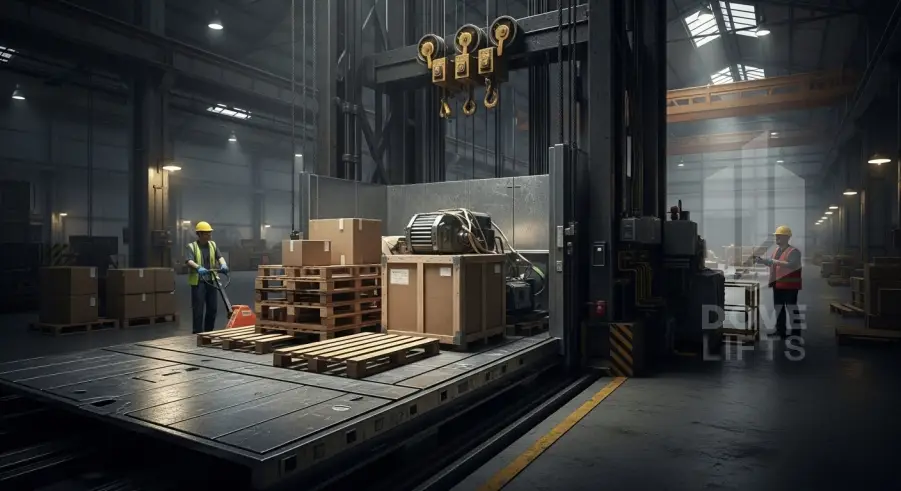
[Image: A freight elevator with open automatic doors at a warehouse receiving bay in Tema, Ghana, with pallets rolling directly from a truck into the cab.]
Positioning the Lift – Receive on Ground, Store on Upper Floors
Place the freight lift at the receiving bay. Load pallets directly from the truck onto the lift. Send them to first-floor storage. No double handling. We have seen Ghana warehouses reduce labour by 40% with this simple layout.
The location of the vertical transportation defines your material flow. If the lift sits at the opposite end from the loading dock, workers must travel long distances. That wastes time and money. In an Accra industrial area like North Industrial Area or Spintex, many older warehouses have narrow corridors. The original design never included a lift system. We audit the floor plan to find the shortest path from truck to storage. A hard fact: The ISO 4190‑5 standard for freight lift dimensions requires a clear landing depth of at least 2.4 metres for fork‑lift access. That same standard applies in Ghana under GS 1307:2005 adoption. We ensure your pit and landing meet this depth.
Direct loading reduces manual touches. Each extra touch adds labour cost and damage risk. In a cold storage warehouse near Tema Port, we positioned the freight elevator directly beside the insulated dock door. Pallets moved from the truck onto the lift platform in one move. The lift then carried them to the first floor for sorting. The owner reported a 40% reduction in casual labour hours. That saving alone paid for the lift upgrade in under a year. The dock crew size was cut from six to three people per shift.
The ground floor station must have a spacious waiting area. Forklifts need room to turn. In tight sites, we use a through‑car design with doors on both the front and rear. This allows the forklift to enter from the dock and exit inside the storage zone. This cuts cycle time further. Dust is a constant challenge in Ghana, especially during harmattan. We place a positive‑pressure fan at the landing doors to keep dust from entering the hoistway. Once the lift position is fixed, the door and control details make the flow even faster.
Door and Control Choices That Speed Up Cycles
Automatic sliding doors save 10 to 15 seconds per trip. Destination dispatch lets you press the floor before entering so the lift is ready. Pallet guides inside the cab reduce positioning time. These features add a modest upfront cost but pay back quickly.
Manual doors slow everything down. A worker must stop the forklift, open the door, drive in, close the door, and repeat at the destination. In a busy warehouse with 50 trips per hour, 10 seconds saved per trip adds up to over 500 seconds per hour. That is nearly ten extra minutes of lift capacity every hour. Automatic horizontal sliding doors are a must for high‑throughput logistics. A hard fact: EN 81‑20 specifies that automatic freight doors must have a light curtain or safety edge that stops and reverses the door if obstructed. We install these with voltage stabilisation to protect the door operator from Ghana’s frequent power fluctuations.
Destination dispatch is another game‑changer. Instead of pressing a button inside the cab, the operator scans a card or taps a screen at the landing. The controller assigns the nearest car. The lift arrives with doors open, ready to load. This eliminates internal button touches and confusion. In a multi‑storey pharmaceutical warehouse in Kumasi, we installed a dispatching system that integrated with the inventory software. When a pallet was scanned, the lift automatically took it to the correct floor. Travel time dropped by 20%. The upfront cost was about ₵15,000 extra, but the throughput gain paid it back in six months.
Inside the cab, pallet guides and a non‑slip floor help forklift operators position faster. We weld shallow angle‑iron guides onto the cab floor to align Euro pallets perfectly. The operator simply drives until the pallet touches the guides. No time is wasted adjusting. The cab floor gets a heavy‑duty chequer plate that withstands forklift tyre wear. In coastal Accra, salty humidity attacks bare steel fast. We apply a marine‑grade epoxy coating to the cab structure and guide rails to prevent rust. The door sills use stainless steel instead of aluminium. These adaptations ensure the lift system runs smoothly through rainy seasons and harmattan dust.
For more on selecting the right freight system, read our pillar post on Freight Elevator Price Ghana. For door specifics, see Automatic Freight Elevator Doors.
Ready to optimise your warehouse flow? We offer a free logistics consultation – we will recommend the lift size, position, and features for your specific Ghana facility.