External Shaft vs Internal Shaft for Elevator Retrofit – Which Is Right for Your Lagos Building?
You have decided to add an elevator. Now you must choose: build a new shaft outside or use an existing internal void. Each has trade‑offs. This guide helps you decide before you call a contractor.
[Image: A split comparison view – left shows an older Lagos building with a retrofitted glass external shaft, right shows an internal stairwell with space marked for a lift opening.]
Internal Shaft (Through‑Stairwell or Lightwell) – Pros and Cons
An internal shaft uses an existing void inside your building, like a wide stairwell or an unused lightwell. It is cheaper because you avoid building a new external structure. Work can be faster. But it is only possible if the void exists and is large enough for a hoistway.
The main advantage is cost. You save the full price of a new concrete or steel tower. In a classic four‑storey colonial building on Broad Street, Lagos Island, a wide internal stairwell allowed us to install a traction drive lift with almost no external work. The building facade stayed untouched. The tenants on upper floors saw only a temporary hoarding around the staircase. Noise and dust were contained inside. A hard fact: Under the Lagos State Building Control law, modifying an internal floor opening still requires a structural engineer’s report. The COREN‑registered engineer must confirm the cut slab does not weaken the building frame. We arrange this report as part of our service.
However, an internal void is rare in many Lagos buildings. Most 1990s apartment blocks in Surulere or Yaba have narrow staircases only 1.2 metres wide. A lift car needs at least a 1.5‑metre‑deep hoistway. Cutting into a staircase can shrink the escape route below the code minimum of 1.1 metres. If the remaining stair width is too small, LASG Fire Service will not approve the plan. The build process also creates daily disruption for occupants. Plaster dust and hammering noise last for weeks. Common areas become construction sites. In a fully occupied residential block, this can strain relations with tenants.
The best candidate for an internal shaft is an old building with a generous lightwell. Some 1970s office towers in Ikoyi have central voids originally designed for air circulation. These often fit a small machine‑room‑less elevator perfectly. We measure every millimetre before you decide. If your building qualifies, this path is cost‑effective and quick. The next option solves the problem when no void exists inside.
External Shaft (Glass or Concrete) – Pros and Cons
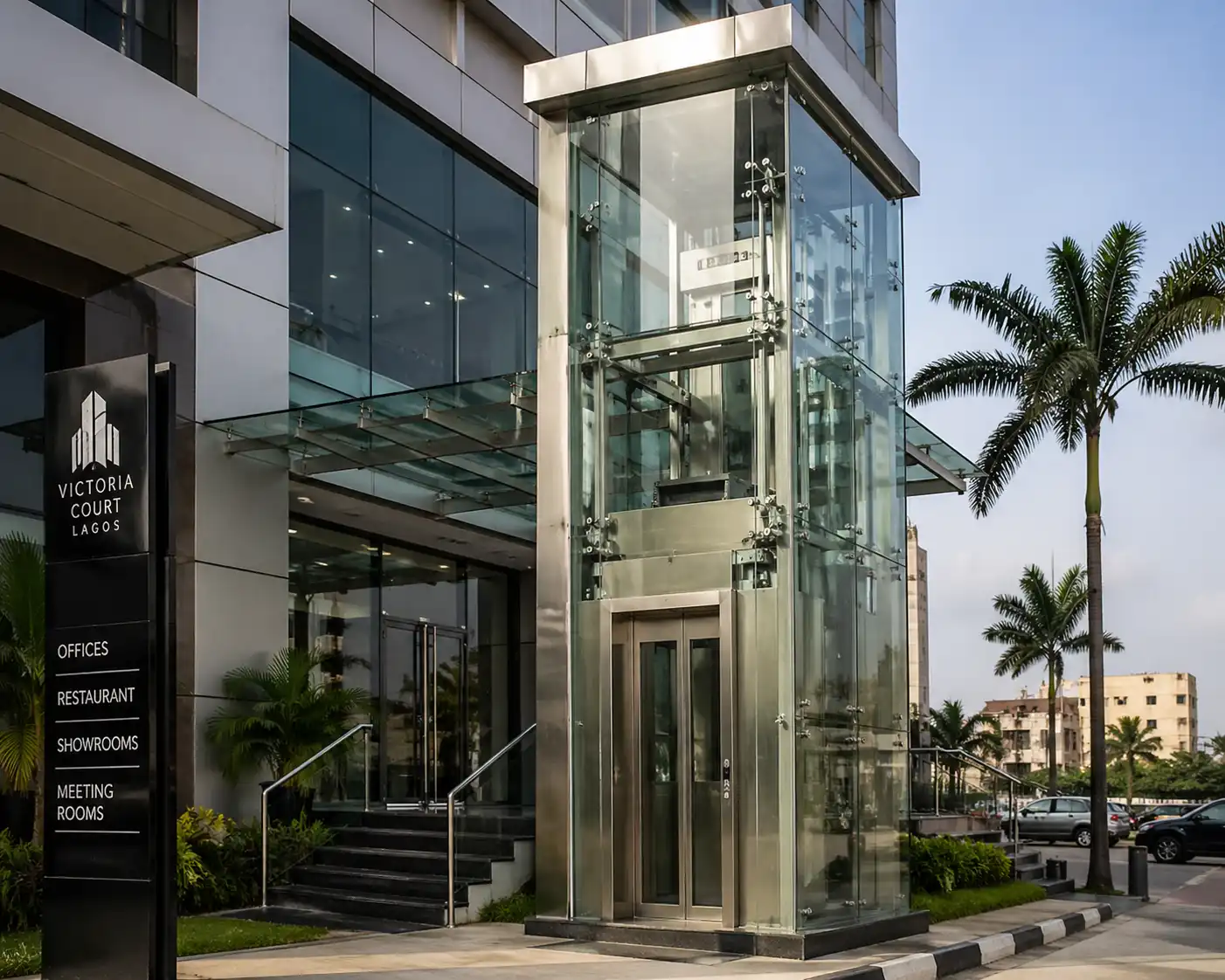
An external shaft is built onto the outside wall of your building. It works for almost any structure, even when there is zero internal space. It causes minimal disruption to tenants. A glass shaft can add a modern architectural look. The downsides are higher cost and a longer permit process.
This is the most common retrofit solution in Lagos today. In high‑density commercial areas like Ikeja and Victoria Island, buildings sit tightly on their plots. There is simply no room to cut a new internal hoistway without losing valuable floor area. An external shaft attaches to the facade beside the staircase or parking area. Tenants stay inside while workers build outside. This saves on temporary relocation costs. A hard fact: The Lagos State Physical Planning Permit Regulations require a setback of at least 3 metres from the plot boundary for any new external structure in a residential zone. In commercial zones, a 4.5‑metre setback may apply. The shaft must also not block natural light or ventilation for neighbouring buildings. We check the setback with a surveyor before drawing the plans.
External shafts cost more because you build a free‑standing structure from the ground up. A concrete shaft with block walls and a roof costs roughly ₦8 million to ₦15 million for a four‑stop lift, depending on soil conditions. In coastal Lekki and Ajah, the sandy soil often needs deeper piling. That adds cost. A glass‑and‑steel shaft looks premium and adds property value, but the glass panels and structural steel frame can push the price to ₦18 million or higher. Yet many commercial landlords choose this path because the sleek look attracts higher‑paying tenants. The external glass elevator in The Wings Office Complex on Victoria Island is a good example. Its glass hoistway became a feature, not a flaw.
Permits are more involved. You need LASG Building Control approval for the new structure. You also need Lagos State Fire Service clearance if the shaft is near a fire escape route. SON CAP certification for the lift equipment is mandatory. The entire approval can take six to eight weeks. We manage the full permit package so you do not lose time.
The external approach suits buildings without any internal void. It also works well when you want to preserve the original interior finishes. After installation, the new shaft becomes part of the building’s envelope. We weather‑proof it to handle heavy rains and the salty air near the coast. For an external project cost breakdown, see our post on External Glass Elevator Cost Lagos. For the complete retrofit planning guide, read Elevator Retrofit Lagos.
Not sure which your building qualifies for? Send us your floor plan (or photos) – we will tell you within 24 hours whether an internal or external shaft is possible.