Elevator Testing and Commissioning in Nigeria: What Happens Before Handover
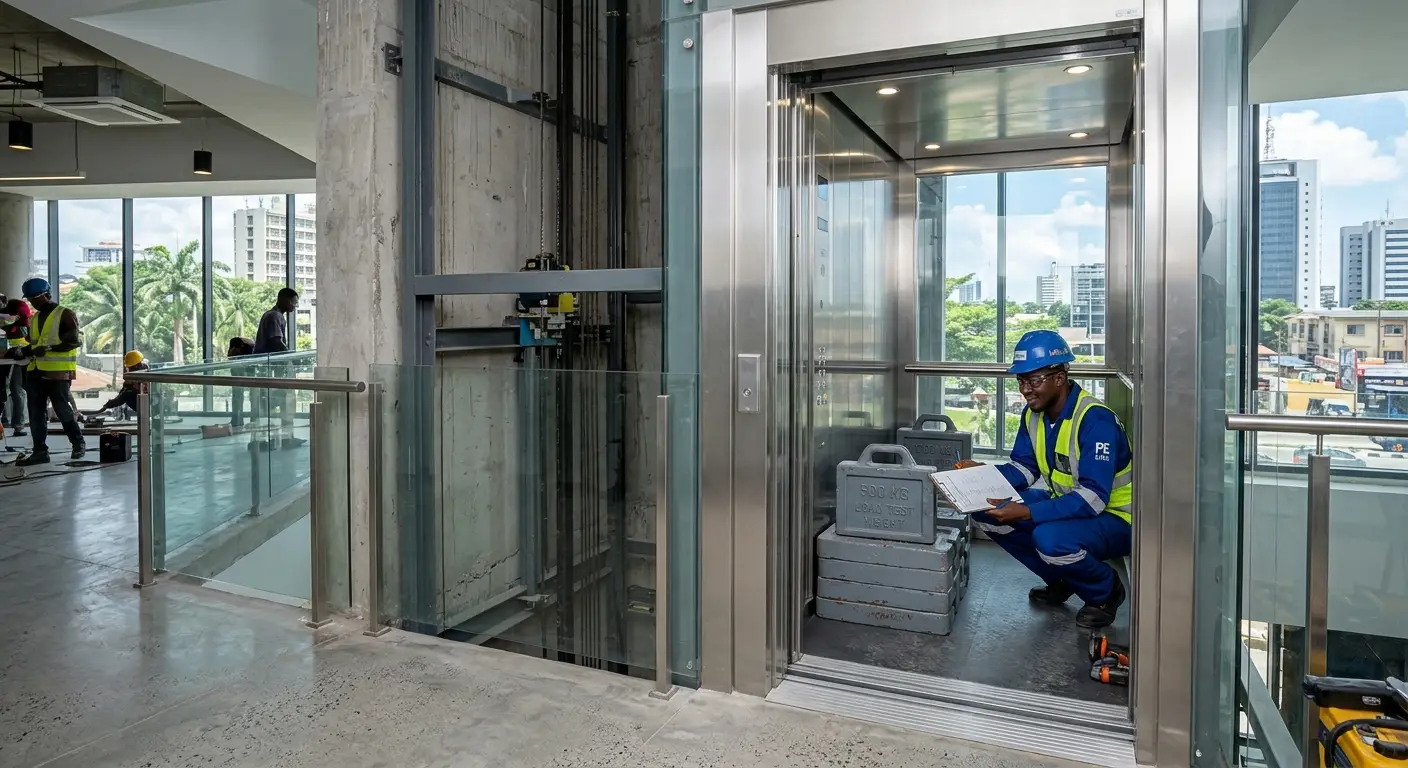
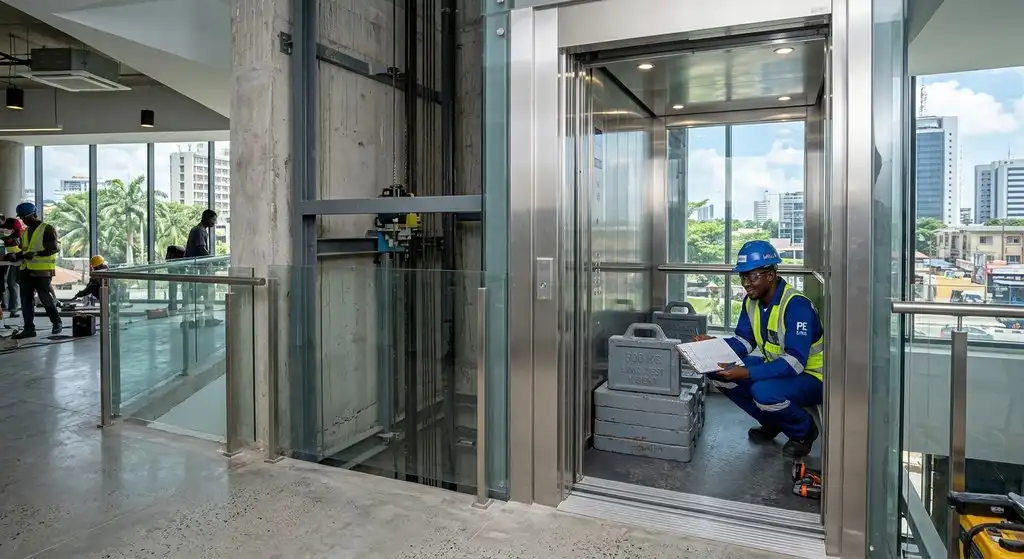
Image suggestion (top of post): A technician with a clipboard and load test weights stacked in an elevator car, with the shaft visible through the open door in a Lagos commercial building.
Alt text: Elevator load test commissioning Nigeria handover inspection Lagos
Introduction
There is a point in every elevator project where the lift looks finished but is not yet safe to operate. The doors slide, the car moves, the lights work. It looks ready.
It is not. Before handover, the lift must be commissioned — a structured process of testing every safety device, verifying every adjustment, and documenting everything for SON inspection. A lift that "works" but has never had its overspeed governor tested, its brake load‑tested, or its automatic rescue device verified under load is not a commissioned lift. It is an unverified installation.
Most building owners do not know what commissioning involves, so they do not know what to ask for. They sign the handover letter, take the keys, and discover the gaps months later when something fails — or when SON inspects.
This guide explains what commissioning actually involves in Nigeria, what the tests mean, and what documentation you must receive before you accept the lift.
Hard fact: SON requires a valid Certificate of Conformity before a passenger elevator can legally operate in Nigeria. The certificate is issued after inspection, and the inspection is only meaningful if the commissioning tests have been properly completed and documented.
Commissioning Is Not the Same as Installation
This distinction matters, because many contractors treat them as one process.
Installation is the physical assembly of the lift — rails, car, doors, machine, controller, wiring. At the end of installation, the lift is mechanically complete.
Commissioning is the verification that the installed system meets its specification and the applicable safety standards. It involves running the lift through a defined set of tests, recording the results, and correcting anything that fails.
A lift can be fully installed and completely uncommissioned. When that happens, the lift may run — but its safety devices have not been verified, its performance has not been measured, and its compliance has not been documented.
What commissioning includes:
- Slow‑speed and full‑speed running tests
- Load tests at rated and overload conditions
- Verification of every safety device
- Adjustment of levelling, door operation, and ride quality
- Documentation of all results
- Preparation for SON inspection
Hard fact: A safety device that has been installed but never tested has no demonstrated function. The overspeed governor, the brake, and the door interlock are all components that may fail silently if not verified during commissioning.
Bridge: The single most important commissioning test is the load test, so let us start there.
The Load Test: Why 125% Matters
Every passenger elevator in Nigeria must pass a load test before handover. This is not a formality.
What the test involves: The car is loaded to 125% of its rated capacity and run through its full travel. For a 1,000kg lift, that means loading 1,250kg of test weights — not passengers, not approximations. The car is driven up and down, stopped at each landing, and the brake is verified to hold without drift.
What the test proves:
- The brake can hold more than the rated load
- The machine has sufficient power to move an overloaded car
- The traction system does not slip under overload
- The car structure and suspension can carry the load
- The safety gear does not activate prematurely
Why 125% and not 100%: The 125% margin is a safety factor. A lift rated for 1,000kg must be able to handle 1,250kg safely, because real loads are not perfectly distributed and because the rated capacity must include a margin for dynamic forces during acceleration and braking.
What "drift" means: After stopping at a landing under load, the car must not creep downward. Even a few millimetres of drift indicates brake weakness. The test measures this.
Hard fact: The 125% load test must be performed with calibrated test weights, not with the car loaded with people or miscellaneous loads. An approximation is not a load test, and it will not satisfy a SON inspector.
Bridge: The load test verifies the brake and structure. The safety devices each require their own verification.
Safety Device Verification: What Must Be Tested
Commissioning verifies every safety device individually. These are the tests that matter.
Overspeed governor. The governor must trip at the correct speed — typically 115% of rated speed — and activate the safety gear. This is tested by simulating overspeed conditions or using a governor test device. A governor that has never been tested may not trip at all, or may trip at the wrong speed.
Safety gear (car and counterweight). The safety gear engages the guide rails when the governor trips. It must be verified to grip correctly without excessive wear to the rails. The test is performed as part of the overspeed verification.
Brake. Beyond the load test, the brake is verified for release clearance, holding force, and stop distance. Brake components are inspected for wear and adjustment.
Door interlocks. Every landing door must be verified to prevent the car from moving unless all doors are closed and locked. The interlock is also verified to prevent a landing door from opening unless the car is at that landing. This is the single most important door safety function.
Door re‑opening sensor. The sensor that stops the door closing when an obstruction is detected must be verified to function correctly. A door that closes onto a passenger's arm causes injury.
Automatic Rescue Device (ARD). The ARD must be tested by simulating a power failure under load — not empty — and verifying that the car descends to the nearest floor at the correct speed and opens its doors.
Emergency communication. The intercom or emergency phone must be verified to reach an attended point, with battery backup functioning.
Fireman's operation. Phase 1 recall and Phase 2 operation must be tested as described in our guide on elevator fire safety in Nigeria. A fireman's switch that has not been tested is a switch that may not work.
Emergency lighting. The car lighting must operate independently on battery for the specified period during a power failure.
Hard fact: Door interlocks cause more injuries in uncertified lifts than any other component. An interlock that permits a door to open when the car is not at that landing is a fatal hazard.
Bridge: With the tests completed and documented, the lift proceeds to SON inspection.
The SON Inspection
SON inspection is the final regulatory step before the lift can legally operate.
What triggers it: The installation is complete, commissioning is complete, and documentation is prepared. The SON inspector is scheduled.
What the inspector checks: The inspection is a verification of the commissioning results, not a repetition of the full test sequence. The inspector will:
- Review the load test documentation
- Verify the safety devices function
- Check door interlocks and operation
- Verify ARD function
- Confirm emergency communication
- Review fireman's operation
- Check the maintenance log and installation documentation
- Verify the equipment is as specified and certified
What happens if it fails: The inspector identifies the failures, and remediation is required before a re‑inspection. This is why we recommend a pre‑SON mock inspection one week before the official date — it catches minor issues before they become scheduling problems.
What you receive: A Certificate of Conformity, which must be displayed inside the car. The certificate is your evidence that the lift is legally operable.
Hard fact: Operating a passenger elevator in Nigeria without a valid SON Certificate of Conformity exposes the building owner to fines exceeding ₦500,000 and, in the event of an incident, to direct liability.
For the full regulatory picture, including LASG Building Control approval, our guide on SON and LASG elevator compliance sets out the complete process.
Bridge: Alongside the certificate, you must receive documentation that will govern the lift's entire operational life.
Documentation You Must Receive at Handover
Accepting a lift without documentation is accepting an asset you cannot maintain, inspect, or verify.
The documentation package must include:
As‑built drawings. The final shaft dimensions, machine room layout, and wiring diagram as installed — not as originally designed. These are essential for any future maintenance or modification.
Electrical drawings. Single‑line diagram, controller wiring, and power supply specifications. Without these, future fault diagnosis becomes guesswork.
Equipment list and specifications. The exact model of every major component — controller, drive, machine, doors, ARD unit. This determines what spare parts to order in future.
Load test certificate. The documented 125% load test results, with the date, the weights used, and the measurements recorded.
Safety device test records. The verification results for each safety device.
SON Certificate of Conformity. The certificate, plus a second copy to display in the car.
Warranty documentation. Written warranty terms, coverage period, exclusions, and the claims process.
Maintenance schedule. The specified service intervals for the installed model, and the first year maintenance arrangement.
Training records. Confirmation that the facility manager and any relevant staff have been trained on daily checks and emergency procedures.
Hard fact: Future maintenance providers need the as‑built drawings and equipment list to service the lift correctly. A building owner who accepts handover without these documents is dependent on the original installer forever — and has no independent record if that relationship ends.
Bridge: These are the failures that most commonly appear at commissioning in Lagos.
Common Commissioning Failures in Nigeria
We have inspected enough installations to know where the gaps are.
Failure 1: Load test not performed, or performed with approximations. The lift is tested with staff inside, or with sandbags weighed by estimate. This is not a load test. The brake may not hold at 125%, and this is only discovered when the lift is fully loaded.
Failure 2: ARD tested empty. The ARD descends with an empty car but has never been tested with passengers. At 125% load, the battery may not complete the descent. This is a direct safety failure.
Failure 3: Fireman's switch installed but not functional. The switch exists, is labelled correctly, but is not wired to the controller, or the controller has never been configured for recall. The switch is decorative.
Failure 4: Door interlocks adjusted to pass, not to function. The interlock functions on a normal test but fails when the door is subject to vibration or misalignment. This is why the interlock must be verified under realistic conditions, not just in a static test.
Failure 5: Documentation incomplete. The lift is handed over with no as‑built drawings, no equipment list, no test records. The certificate is displayed, but the operational record does not exist.
Failure 6: Power protection not verified. The lift has an ARD but no surge protection, or the protection is installed but not verified. In a Lagos building with voltage fluctuations, this is a failure waiting to happen.
Hard fact: In our experience, the most common commissioning failure in Nigeria is documentation — not function. The lift passes its physical tests, but the building owner receives no as‑built drawings, no equipment list, and no test records. This makes every future maintenance action more difficult and more expensive.
Bridge: These are the questions building owners ask us most often about commissioning.
Frequently Asked Questions
What is the difference between installation and commissioning?
Installation is the physical assembly of the lift. Commissioning is the verification that the installed system meets specification and safety standards, with documented test results. A lift can be fully installed and completely uncommissioned.
How long does commissioning take?
It depends on the scope and whether the inspection is scheduled promptly. The tests themselves can typically be completed within a few days, but scheduling SON inspection adds time. A pre‑SON mock inspection is recommended one week before the official date.
What is the 125% load test?
The car is loaded to 125% of its rated capacity and run through its full travel. The brake must hold without drift, the machine must move the car without slipping, and the car structure must carry the load safely. It is mandatory before SON inspection.
Do all lifts need a load test?
Yes. Every passenger elevator must have a documented 125% load test before handover and at the required inspection intervals thereafter.
What documents should I receive at handover?
As‑built drawings, electrical drawings, equipment list and specifications, load test certificate, safety device test records, SON Certificate of Conformity, warranty documentation, maintenance schedule, and training records.
What happens if the lift fails SON inspection?
The failures are identified and remediation is required before re‑inspection. This is why a pre‑SON mock inspection is recommended — it catches issues before the official date.
Can I accept a lift without documentation?
You can, but you should not. Without as‑built drawings and equipment records, every future maintenance action becomes more difficult and more expensive. Accepting handover without documentation means depending on the original installer forever.
What is a pre‑SON mock inspection?
A full review of the installation against the SON requirements, performed one week before the official inspection. It catches any issue that would cause the official inspection to fail, allowing correction in time.
Hard fact: The load test and safety device verification must be repeated at the intervals required by SON, not just at handover. The initial commissioning record is the baseline against which future inspections are compared.
Is Your Lift Properly Commissioned?
If you have an existing elevator and are not sure whether it was properly commissioned, the test records will tell you. If they do not exist, the lift has not been verified to the standard required.
We can assess your installation and produce a commissioning report that shows exactly what has been tested, what has not, and what needs to be done. Where documentation is missing, we can reconstruct it from site verification. Where testing is due, we can schedule it.
We do not publish fixed figures for commissioning or assessment, because scope varies by lift type and condition. What we can do is assess your installation and give you a written report with clear findings.
Send us your lift details — age, brand if known, number of stops, and whether you hold any handover documentation. We will tell you what your commissioning position actually is.
👉 Speak to Dove Lifts about elevator testing and commissioning
Dove Lifts — Traction, MRL, hydraulic, and freight elevator installation, commissioning, modernization, and maintenance across Nigeria and West Africa. Documented testing, SON certification support, and complete handover packages.