Elevator Fire Safety in Nigeria: Fire‑Rated Shafts, Fireman's Operation, and Lagos Fire Code Compliance
.
Introduction
Fire is the one scenario where an elevator can kill people who trusted it. During a fire, an elevator shaft can act as a chimney — drawing smoke and flames upward through the building faster than any other pathway. A lift that stops on a smoke‑filled floor, or opens its doors onto a corridor consumed by fire, becomes a trap.
This is why fire safety for elevators is not an add‑on. It is a defined set of engineering requirements — fire‑rated shaft walls, smoke seals at landing doors, fireman's recall operation, and a firefighter control system that overrides normal operation.
In Nigeria, these requirements are enforced through the Lagos State Fire Code, SON standards, and the international EN 81 series. Yet many buildings in Lagos operate lifts that fail on fire safety basics: no fire recall operation, no fire‑rated doors, and no documented test of the fire mode.
This guide explains what Nigerian building owners must know — what the codes require, how fireman's operation actually works, and what inspectors check.
Hard fact: EN 81‑58 sets the standard for fire‑resisting landing doors on lifts. Lagos State Fire Code requires lifts serving firefighting operations to comply with fireman's operation and fire‑rated shaft construction. A lift that fails either requirement is non‑compliant.
Why Elevators Are Dangerous During Fires
Understanding the risk makes the requirements make sense.
The shaft acts as a chimney. An elevator hoistway is a continuous vertical void from the pit to the top of the building. In a fire, hot smoke rises through it rapidly, drawing from lower floors to upper. If the shaft is not fire‑rated and sealed at each landing, it becomes a pathway for smoke to reach every floor.
Passengers can be delivered into the fire. A person who uses the lift during a fire presses a landing button and the car arrives — potentially at the floor that is burning. The doors open onto smoke and heat. The passenger has walked into the fire.
Power can fail and trap occupants. Fire damages electrical infrastructure. If the lift is moving when power fails, passengers may be trapped between floors in a smoke‑filled shaft. This is why automatic recall to the ground floor on fire detection is critical.
The lift cannot be used for evacuation. It is the most important rule, and the most misunderstood. Lifts are not evacuation routes. Stairs are. The purpose of fireman's operation is not to evacuate people — it is to allow trained firefighters to use the lift to fight the fire.
Hard fact: The lift has no role in occupant evacuation during a fire. Its only fire‑related function is to recall to the ground floor on detection, and then to serve firefighters under key control.
Bridge: These risks are addressed through a defined set of design requirements.
Fire‑Rated Shafts and Landing Doors — The First Line of Defence
The shaft is where fire safety begins. If smoke can enter the shaft, everything else fails.
Fire‑rated shaft walls. The hoistway must be enclosed in fire‑resistant construction with a defined fire resistance rating — typically two hours in commercial and high‑rise buildings. In Lagos, this means reinforced concrete, concrete block with appropriate finishes, or a rated drywall system. The shaft wall must be continuous from the pit floor to the underside of the roof slab or machine room.
Fire‑rated landing doors. Every landing door must be fire‑rated to EN 81‑58 or an equivalent standard. Fire‑rated doors are constructed with materials that resist fire penetration and are fitted with intumescent seals — strips that expand when heated, sealing the gap between the door and frame.
Smoke seals at every landing. Even a small gap between the lift door and the landing frame allows smoke to pass. Smoke seals close that gap. They are a small, inexpensive component that makes an enormous difference in fire conditions.
Ventilation openings. Some shaft designs include ventilation at the top and bottom of the hoistway. These must be protected with fire dampers that close automatically on detection of heat, so they do not become smoke pathways.
What we frequently find in Lagos: Older lifts with non‑rated doors, missing intumescent seals, and shaft walls that have been penetrated for wiring or ductwork without fire stopping. Each of these is a fail point in a fire.
Hard fact: Fire‑rated landing doors must be tested and certified as a complete assembly — door, frame, seals, and hardware. Substituting components after installation voids the fire rating, even if each component is individually rated.
For the retrofit case, where shaft walls and door openings are being modified, our guide on elevator retrofit in Lagos covers how fire‑rated construction is maintained through the process.
Bridge: Fire‑rated construction contains the fire. Fireman's operation gives the fire service a tool to fight it.
Fireman's Operation — Phase 1 and Phase 2 Explained
Fireman's operation is the system that allows firefighters to take control of a lift during a fire. It has two phases.
Phase 1 — Fire Recall. When a smoke detector in the lift lobby, machine room, or shaft activates, the fire recall system takes over. The lift:
- Cancels all existing car and landing calls
- Returns directly to the designated fire recall floor (usually the ground floor)
- Opens its doors and parks with doors open
- Remains unavailable for normal use
This prevents passengers from being delivered to a smoke‑filled floor and ensures the lift is at the ground floor where firefighters can access it.
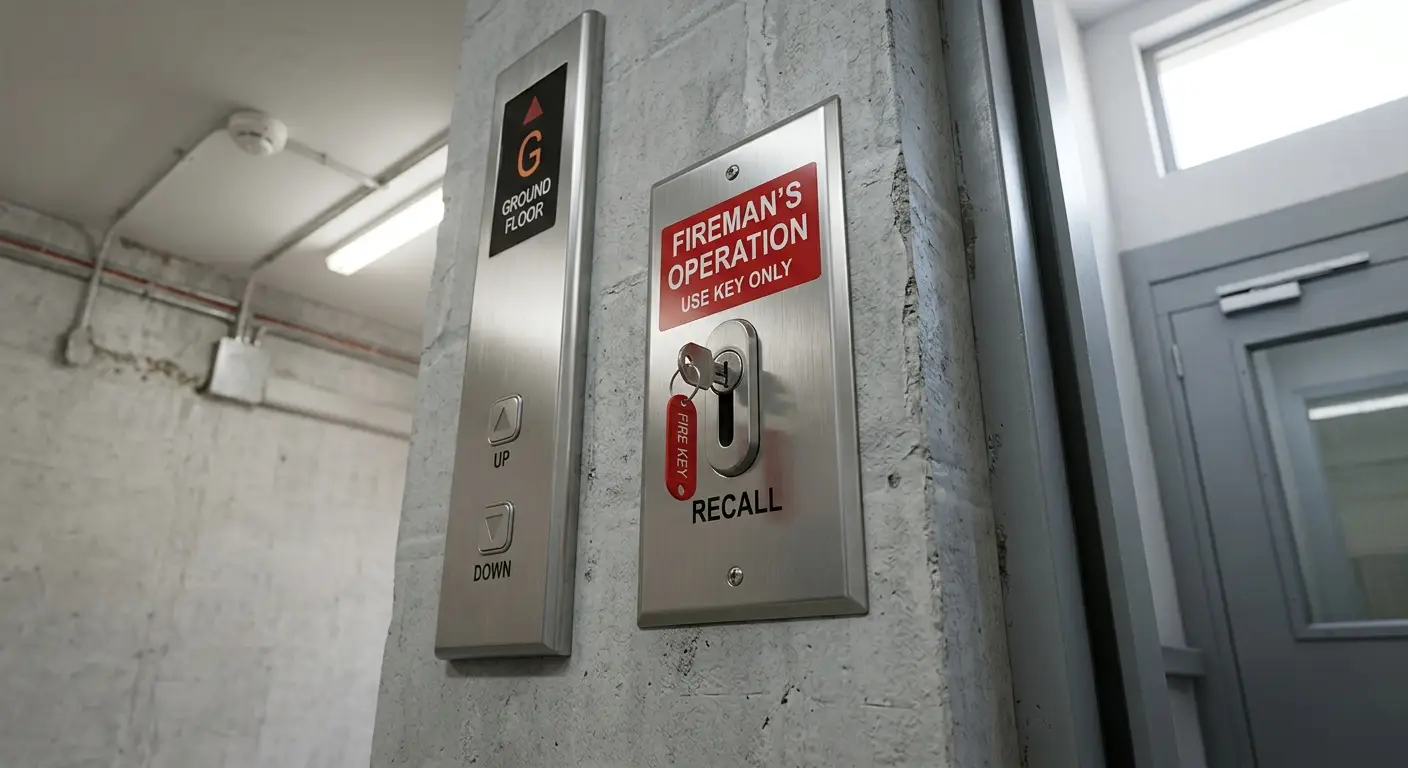
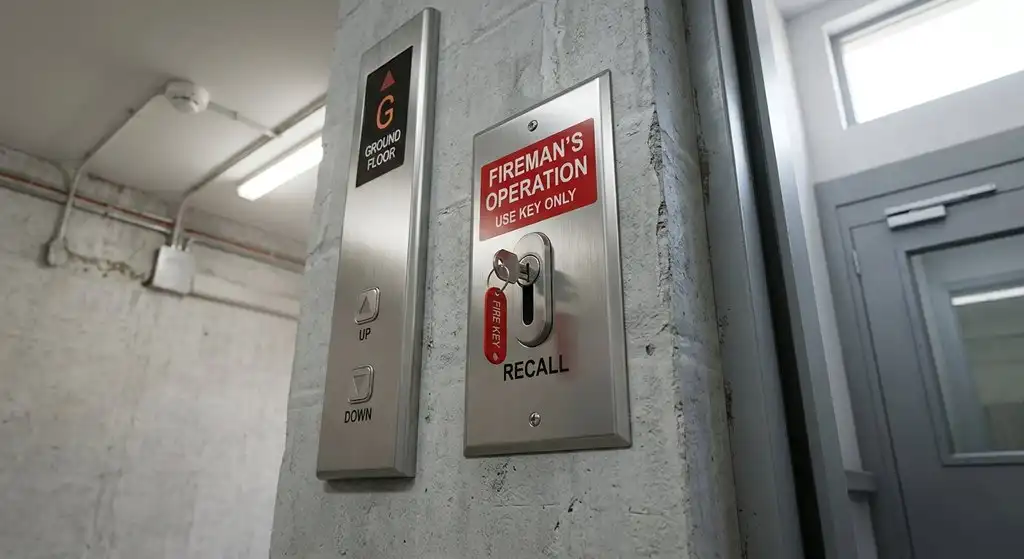
Phase 2 — Firefighter Control. Once the lift is at the recall floor, a firefighter inserts a special key into the landing switch or car switch. This activates Phase 2. In Phase 2:
- The lift operates only under continuous pressure on the control buttons
- The firefighter must hold the door close or floor selection button for the lift to move
- If the button is released, the lift stops immediately
- The lift will not respond to landing calls
- The doors will not open automatically
This allows a firefighter to take the lift to a specific floor to fight the fire, with full control and no automatic behaviour that could put them in danger.
How it is tested. Fireman's operation must be functionally tested — not just installed. The test simulates a smoke detector activation and verifies that Phase 1 recall works, and then verifies that Phase 2 operation works under key control.
What we frequently find in Lagos: Lifts with fireman's switches installed but not wired to anything. Lifts where Phase 1 recall activates but the lift then behaves normally — because the Phase 2 key switch was never connected or the controller was never configured. A fireman's switch that does not work is worse than no switch, because it creates false confidence.
Hard fact: Fireman's operation must be tested at installation and annually thereafter. The test must be documented. An untested fireman's system has no demonstrated capability — it is a switch that may or may not work.
For hospital installations, where fireman's operation interacts with patient transport considerations, our guide on hospital elevator requirements in Nigeria covers the healthcare‑specific requirements.
Bridge: The requirements are clear. Enforcement is where the picture gets more complicated.
What Lagos State Fire Code Requires
Lagos State has specific requirements for elevator fire safety, enforced through the Fire Service and LASG Building Control.
Fire service approval at construction stage. Any lift installation — particularly with an external shaft — requires fire service approval to confirm it does not obstruct fire escape routes or firefighting access.
Fireman's operation. Lifts in buildings above a defined height, or serving defined occupancies, must be equipped with fireman's operation. This includes most commercial buildings, hotels, hospitals, and residential towers.
Fire‑rated construction. Shaft walls and landing doors must meet the fire resistance requirements defined in the code. The fire service inspects at construction and may re‑inspect at completion.
Signage and identification. Lifts with fireman's operation must be clearly identified with signage indicating the fire service function. The fireman's switch must be clearly marked and accessible.
Documentation. The fire service requires documentation of the fire safety features — fire rating certificates, fireman's operation test records, and the SON Certificate of Conformity.
What happens if you fail: The building may be prevented from occupying, or the lift may be shut down pending remediation. Insurance claims in the event of a fire are at risk if the fire safety systems are not compliant.
Hard fact: In the event of a fire in a building where the lift's fireman's operation was not functional, the building owner carries direct liability — regardless of whether the lift caused the fire.
Bridge: The requirements are not just regulatory. They are the practical measures that make a lift safe to have in a building at all.
What Inspectors Actually Check
Whether the inspection is by the Lagos State Fire Service, SON, or an insurance assessor, these are the items that come up.
Fire‑rated door certification. The doors must be certified to the correct standard. The inspector will want to see the certificate, and may inspect the door assembly for the intumescent seals.
Fireman's operation function. The inspector will simulate a smoke detector activation and observe the Phase 1 recall, then test Phase 2 under key control. If either phase does not work, the lift fails.
Smoke detector integration. The lift's fire recall must be wired to the building's fire detection system — not to a standalone detector that no one tests. The integration must be verified.
Shaft fire stopping. Any penetration of the shaft wall — for cables, ducts, or pipes — must be fire stopped with approved materials. An inspector checking the shaft will look for gaps that have been filled without rated materials.
Signage. Fireman's switches must be identified and accessible. The lift must have appropriate fire safety signage.
Documentation. The maintenance log must show fireman's operation tested at the required intervals. The fire service may also ask to see the original fire approval documentation.
Hard fact: Fireman's operation and fire‑rated doors are inspection items that building owners frequently fail on first inspection. In many cases, the features are installed but never tested or documented — which is a fail.
For the wider compliance picture, including SON and LASG permits, our guide on SON and LASG elevator compliance sets out the full process.
Bridge: For buildings being modernized or retrofitted, fire safety is one of the areas where older installations most frequently fall short.
Fire Safety in Modernization and Retrofit
If you are modernizing an old lift, fire safety is the area where the gap between the existing installation and current requirements is largest.
Doors are the most common problem. Older lifts often have doors that were not fire‑rated to current standards. Replacing doors with fire‑rated assemblies is usually necessary to achieve compliance.
Fireman's operation is often absent. Lifts installed before fireman's operation was widely required may have no recall function at all. Adding it requires a fire‑rated smoke detector circuit, a controller configured for recall, and a fireman's key switch at the landing and in the car.
Smoke seals are frequently missing. Even a fire‑rated door assembly loses effectiveness if the intumescent seals have aged or been removed. Replacing seals is a small cost that restores the fire rating.
Shaft penetrations are often unsealed. Modernization work involves new wiring, which must be fire stopped at every shaft penetration. This is a detail that is frequently missed.
Why this matters commercially. A modernization project that does not bring the fire safety systems up to current standards will fail inspection, and the building may not be able to operate the lift until remediated. This is one of the reasons we recommend a full fire safety audit as part of any modernization project.
Hard fact: Fire‑rated landing doors are a mandatory component of any modernization that touches the door system. Substituting a non‑rated door to save cost voids the fire compliance of the installation.
For the full modernization picture, our guide on elevator modernization in Lagos covers what gets replaced and how fire safety fits into the scope.
Bridge: These are the questions building owners ask us most often about elevator fire safety.
Frequently Asked Questions
Is an elevator safe to use during a fire?
No. An elevator should never be used for evacuation during a fire. The shaft can fill with smoke, the lift may stop at a fire floor, and power may fail. Stairs are the evacuation route. The purpose of fireman's operation is to allow firefighters to use the lift — not for general use.
What is fireman's operation on an elevator?
A system with two phases. Phase 1 automatically recalls the lift to the ground floor when a smoke detector activates, cancelling all calls and opening the doors. Phase 2 allows a firefighter with a key to take manual control of the lift, operating it under continuous button pressure with no automatic behaviour.
Do all buildings in Nigeria need fireman's operation?
It is required for lifts in buildings above a defined height, and for defined occupancies including commercial buildings, hotels, hospitals, and residential towers. Lagos State Fire Code and SON requirements apply. The specific threshold depends on the building type and height — a site assessment determines applicability.
What is a fire‑rated elevator door?
A door assembly tested and certified to resist fire penetration for a defined period — typically to EN 81‑58. It includes the door panels, frame, and intumescent seals, which expand when heated to close gaps. The fire rating applies to the complete assembly, not individual components.
How often should fireman's operation be tested?
At installation, at any modernization, and annually thereafter at minimum. The test must be documented in the maintenance log. The fire service or SON may inspect and require evidence of recent testing.
What happens if the fireman's switch is installed but not working?
This is a compliance fail, and a serious safety issue. A switch that does not work creates false confidence. The building owner carries liability, and insurance claims in the event of a fire are at risk. The fault must be found and corrected, and the system tested to confirm function.
Can a lift without fireman's operation be brought into compliance?
Usually yes, by retrofitting the required components — smoke detector integration, controller configuration for recall, and fireman's key switches at the landing and in the car. This is common in modernization projects where the fire safety gap is identified.
What should I do if my building has an old lift and I am not sure about fire safety?
Commission a fire safety assessment. The assessment should verify fire‑rated doors, smoke seals, shaft fire stopping, fireman's operation function, and documentation. If any of these fails, the lift requires remedial work before it can be considered compliant.
Hard fact: Fire‑rated door assemblies must be inspected periodically. Intumescent seals degrade with age and heat exposure. A door that was compliant at installation may not be compliant five years later if the seals have been damaged or removed.
Is Your Building's Elevator Fire‑Safe?
Fire safety is the area where the gap between "the lift works" and "the lift is compliant" is widest. Many lifts in Lagos operate daily with fireman's switches that are not wired, doors that are not fire‑rated, and no documented fire safety testing.
We can tell you what your building's actual position is. We will assess the fire‑rated construction, verify fireman's operation function, check smoke seals and shaft fire stopping, and provide a written report with clear remediation priorities. Where the lift is non‑compliant, we will give you a scope of works to bring it into compliance — with cost categories clearly separated.
We do not publish fixed figures for fire safety assessments or remediation, because scope varies by lift type, age, and building. What we can do is assess your installation and give you a written proposal.
Send us your lift details — age, brand if known, number of stops, and building type. We will tell you what your fire safety position actually is.
👉 Speak to Dove Lifts about elevator fire safety
Dove Lifts — Traction, MRL, hydraulic, and freight elevator installation, modernization, and maintenance across Nigeria and West Africa. Fire‑rated door supply, fireman's operation integration, and documented fire safety testing.