Introduction
Lagos land is expensive. Every square metre of ramp you build to move a car between floors is a square metre you cannot sell, rent, or park on. That is the core reason car elevators exist in this market — not luxury alone, but economics.
A car elevator lifts a vehicle vertically on a platform, replacing the long sloping ramp that would otherwise consume the footprint of a small apartment. For a Victoria Island showroom that wants cars on display across two levels, or a Lekki duplex with a basement garage, a vehicle lift can be the difference between a workable layout and a compromised one.
This guide covers how car elevators work, where they are specified in Lagos, what drives the cost, and what to plan before installation.
Hard fact: Every car elevator must be rated for at least 125% of the maximum vehicle load it will carry. For a platform serving SUVs, that means designing for well over 2,500kg — not the weight of an empty saloon.
How a Car Elevator Works
A car elevator is a heavy‑duty vertical platform, not a passenger lift scaled up. The engineering is different in three important ways.
Load distribution. Vehicles place concentrated loads on four small contact patches — the tyres. The platform deck must be reinforced and stiffened to prevent deflection across those points. A platform that flexes under a car will crack, warp, and eventually fail its guide alignment.
Platform dimensions. A passenger lift cab is sized for people. A car platform must accommodate the full vehicle footprint plus clearance for the driver to open the door and step out. In practice this means longer, wider, and heavier than any comparable passenger unit.
Drive system. Hydraulic drives dominate car elevators up to a few floors because they handle heavy loads smoothly and require a shallower pit. Traction drives are used for taller installations and higher duty cycles, but the deeper pit and machine room requirements must be designed in from the start.
Hard fact: Car elevator platforms must be fitted with mechanical safety locks that engage when the platform is at a landing. Without them, a platform under load can creep or drop as hydraulic pressure bleeds — a failure mode that has caused vehicle losses and injuries internationally.
Bridge: With the mechanics clear, the next question is where these systems actually make sense in Lagos.
Where Car Elevators Make Sense in Lagos
Not every building needs a vehicle lift. These are the four situations where we consistently see them specified.
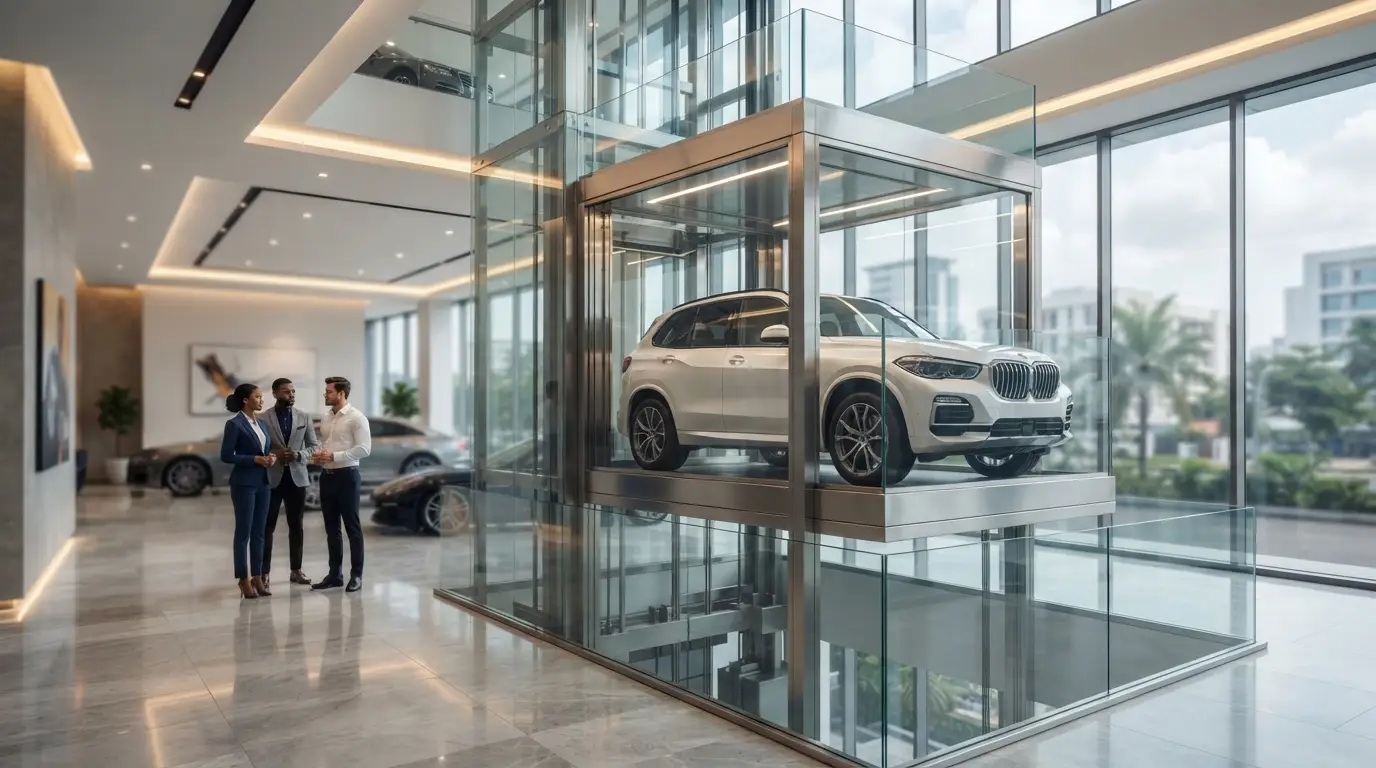
Car showrooms. Multi‑level showrooms want vehicles visible across floors without the buyer driving up a ramp. A glass‑walled car elevator becomes part of the display — customers ride with the car. In Victoria Island, Ikoyi, and Lekki showrooms, this doubles as a marketing feature.
Luxury duplexes and villas. A basement garage in a Lekki or Ikoyi home is practical, but the ramp required to reach it consumes ground floor area and often conflicts with the boundary. A car elevator solves the geometry problem, and it also protects vehicles from Lagos flood water by keeping them above ground level until lifted down.
Basement parking in tight plots. On small plots where a compliant ramp gradient cannot be achieved within the available length, a car lift is often the only way to reach basement parking. This is common on Ikoyi and Banana Island plots where setbacks are tight.
Automotive workshops and dealership service bays. Where vehicles move between diagnostic, wash, and storage levels, a lift reduces turnaround time and removes the need for ramps that consume working floor area.
Hard fact: A car elevator is not a substitute for a compliant ramp where planning approval requires one. In many Lagos schemes you need both — the lift for premium access and the ramp to satisfy LASG Building Control and fire access requirements.
For the retrofit case specifically, the constraints are similar to adding any lift to an existing building — our guide on elevator retrofit in Lagos covers the structural assessment process in detail.
Bridge: Once you know a car lift fits your building, the next step is understanding what drives the cost.
What Affects the Cost of a Car Elevator
We do not publish fixed prices, because a car elevator is engineered around a specific vehicle and a specific building. What we can do is tell you which variables move the number.
Vehicle size and weight. A platform specified for a saloon is a different machine from one specified for a Land Cruiser, a pickup, or a delivery van. Load rating drives platform steel thickness, guide rail size, drive capacity, and pit construction.
Number of stops. Each additional landing adds doors, landing call stations, guide rail, wiring, and structural openings. Vertical travel also affects the drive system choice.
Drive type. Hydraulic systems are typically more economical for two to three stops. Traction systems become competitive at greater heights and higher cycle frequencies — but require deeper pits and more overhead clearance.
Platform configuration. An open platform with drive‑on ramps is simpler and cheaper. An enclosed cab with walls and roof — for weather protection or security — adds cost. Glass‑walled display platforms cost more again.
Shaft construction. An internal shaft built into the structure is different from an external steel shaft bolted to the building. External shafts require their own foundation, weatherproofing, and often planning approval.
Site access for installation. Getting a multi‑tonne platform and drive unit into a tight Ikoyi plot requires crane access, which must be planned and can influence the installation cost.
Hard fact: The pit for a car elevator is typically deeper than a passenger lift pit, because hydraulic cylinders and buffers must be accommodated under a platform designed for far greater loads. If you cannot achieve the pit depth, the design must change.
For a sense of how equipment versus civil works split in practice, our breakdown of elevator installation cost in Nigeria uses the same cost categories that apply here.
Bridge: Understanding cost drivers is useful — but the real planning work happens before any quotation.
What to Plan Before You Install
Car elevators fail at the planning stage far more often than at the installation stage. These are the decisions that must be locked down first.
Confirm the maximum vehicle, not the typical one. Specify for the largest vehicle that will ever use the lift — including a fully loaded pickup or a delivery van. Under‑specifying to save money on the equipment means replacing the entire unit later.
Confirm the drive‑on direction. Will the car drive straight through, or turn on the platform? A turn‑on platform requires more width and depth, and affects whether you need doors on one side or two.
Confirm the driver exit path. The driver must be able to open the door and step out safely at every landing. On tight platforms this often means a side door arrangement rather than front exit.
Confirm floor slab capacity at every landing. The platform load transfers to the building at each landing, not just at the pit base. Older Lagos buildings frequently need local reinforcement at landing level.
Confirm water management. For basement garages, both the pit and the basement itself must be protected against Lagos rainy season water. A flooded pit stops the lift entirely and damages the drive unit and controls.
Confirm the power supply. Car elevators draw significant current, particularly hydraulic units starting under load. A dedicated three‑phase supply with surge protection is standard. Generator backup is recommended where vehicles could otherwise be trapped on the platform.
Hard fact: A vehicle trapped on a car elevator platform during a power outage cannot be recovered by hand. The platform is too heavy to manually lower safely without the correct hydraulic release procedure performed by a trained technician.
Bridge: With planning complete, the final question is what a realistic project timeline looks like.
Installation Timeline and Disruption
Expect a longer programme than a passenger lift, mainly because the platform and drive unit are heavier and site access is more demanding.
A typical Lagos car elevator project — new shaft, two stops, one vehicle — follows roughly this sequence:
| Phase | Duration | Notes |
|---|---|---|
| Technical survey and platform sizing | 1 week | Confirms vehicle dimensions and drive‑on direction |
| Structural assessment and pit design | 1–2 weeks | COREN engineer report where required |
| Equipment manufacture or stock release | 4–10 weeks | Depends on whether the platform is a standard size |
| Shaft and pit construction | 4–8 weeks | Sequential — cannot overlap with platform install |
| Platform and drive installation | 3–4 weeks | Crane access required |
| Testing, load test, and certification | 1–2 weeks | Includes 125% load verification |
| Handover and driver briefing | 1 day | Operating procedure and emergency release |
For showrooms, we generally recommend installation during the fit‑out stage, before display lighting and flooring are completed. Retrofitting after the showroom opens means working around live vehicle displays and customer areas.
Hard fact: The 125% load test on a car elevator requires a vehicle or ballast matching the rated load. This test must be witnessed and documented before the unit is certified for operation.
For the wider context on how elevator timelines fit into construction programmes, see our traction elevator installation timeline.
Bridge: Here are the questions we are asked most often about car elevators in Lagos.
Frequently Asked Questions
Can a car elevator be installed in an existing building?
Yes, but it requires a structural assessment first. The pit, landing openings, and floor slab loads must all be verified. Many Lagos buildings can accommodate a car lift with local reinforcement rather than major structural work.
How much does a car elevator cost in Lagos?
It depends on the platform size, number of stops, drive type, enclosure, and shaft construction. A compact two‑stop platform for a single saloon is a different project from a four‑stop glass‑walled display unit for SUVs. We provide project‑specific quotations after a site survey.
Can the car elevator carry people as well as vehicles?
Some models are certified for accompanied vehicle transport, meaning the driver rides with the car. This requires additional safety features — enclosed car, emergency lighting, alarm, and intercom. Confirm this requirement at specification stage, because it changes the design.
What happens if the power fails with a car on the platform?
A hydraulic car elevator can be lowered using a manual release valve operated by a trained technician. Traction units with an ARD can descend to the nearest landing under battery power. Neither should be attempted by untrained staff.
Do I still need a ramp if I install a car elevator?
Often yes. Fire access, building code compliance, and general circulation usually require at least one ramp. The lift supplements the ramp for premium or high‑frequency access — it does not always replace it.
Can the platform be sized for two cars at once?
Yes, larger platforms can carry two vehicles side by side, or one vehicle plus pedestrians. This increases platform steel, drive capacity, shaft dimensions, and pit depth. It is common in dealership service operations.
Is a car elevator suitable for a residential duplex?
Yes. A two‑stop hydraulic car lift for a basement garage is a common specification in Lekki and Ikoyi homes. It preserves ground floor area that a ramp would otherwise consume.
Hard fact: Any car elevator installed in Nigeria requires SON certification before operation, in addition to any LASG Building Control approval for the shaft structure.
Planning a Car Elevator in Lagos?
Vehicle lifts are an engineering problem before they are a purchasing decision. Get the platform size, drive direction, pit depth, and structural loads right at the start, and the rest follows cleanly.
We do not publish fixed figures, because a car elevator is built around your vehicle and your building. What we can do is survey your site, size the platform correctly, confirm what your structure can carry, and give you a written quotation with the cost categories clearly separated — equipment, shaft, installation, and certification.
Send us the vehicles you need to move and a photo of your intended location. We will tell you what is feasible and what to budget for.
👉 Speak to Dove Lifts about a car elevator for your building
Dove Lifts — Car elevators, traction and MRL lifts, escalators and moving walkways specified, installed, and maintained across Nigeria and West Africa.